

Introduction
If you could read my mind, you would find yourself in the presence of Vivien Burr, Susie Scott and Fr Gerald A. Arbuckle, SM. A strange mix of people, to be sure, but very much a part of my mind at present, and for reasons that relate to the Gospel you are about to read.
Vivien Burr is a social psychologist and works in the Department of Psychology at the University of Huddersfield. Susie Scott is Professor of Sociology at the University of Sussex. Both have written about identity as a social construct and this is why I link them with Fr Gerald and the Gospel reading.
For most of my life, I have been a social constructionist, at least by default. And I have been a Catholic for much longer than that. But religion (in my case, Catholicism) is a social construct. Fr Gerald has written about the existence of differing Catholic identities in the Church. And while I do not know anything about the religious beliefs and practices of Burr and Scott, I do know that they acknowledge the part that religion plays in society.
More important than this is Fr Gerald’s emphasis on Jesus’ appeal to people’s imaginations through his storytelling and through miracles that reveal the amazing power of God, as you will find in this Gospel. I am sure that there is a strong relationship between Cardijn’s See, Judge, Act method, which is used here, and the lesson about faith that Jesus teaches through his solidarity with the poor. All is gift and there will always be more than enough for each and every person who relates with God.
The Gospel
When Jesus received the news of John the Baptist’s death he withdrew by boat to a lonely place where they could be by themselves. But the people heard of this and, leaving the towns, went after him on foot. So as he stepped ashore he saw a large crowd; and he took pity on them and healed their sick.
When evening came, the disciples went to him and said, ‘This is a lonely place, and the time has slipped by; so send the people away, and they can go to the villages to buy themselves some food.’ Jesus replied, ‘There is no need for them to go: give them something to eat yourselves.’ But they answered ‘All we have with us is five loaves and two fish.’ ‘Bring them here to me’ he said. He gave orders that the people were to sit down on the grass; then he took the five loaves and the two fish, raised his eyes to heaven and said the blessing. And breaking the loaves handed them to his disciples who gave them to the crowds. They all ate as much as they wanted, and they collected the scraps remaining; twelve baskets full. Those who ate numbered about five thousand men, to say nothing of women and children. (Matthew 14:13-21)
The Enquiry
See
What is the major difference between the apostles’ attitude towards the thousands who came to listen to Jesus and that of Jesus himself? Have you ever, like the apostles, made excuses to avoid helping people in need?
How are those who choose to follow Jesus impacted by their decision (Look at the people who are fed and the apostles.)? What experiences have you had that validate the Gospel story?
Why does Jesus resist the pressure to conform to his apostles’ lack of concern for the people who have travelled to listen to him?
Judge
Do you accept that Jesus fed thousands of people with just a few loaves and some fish? Or do you find yourself looking for an acceptable interpretation?
What would life be like if we looked at the world in the way that Jesus does?
What do you find difficult to accept in this story and use it to shape your life in imitation of Jesus?
Act
What have you observed in this Gospel story that is needed in the world?
What small action can you carry out that will contribute to bringing about this transformation of the world and yourself?
Who can you involve in your action, when, where and how often?
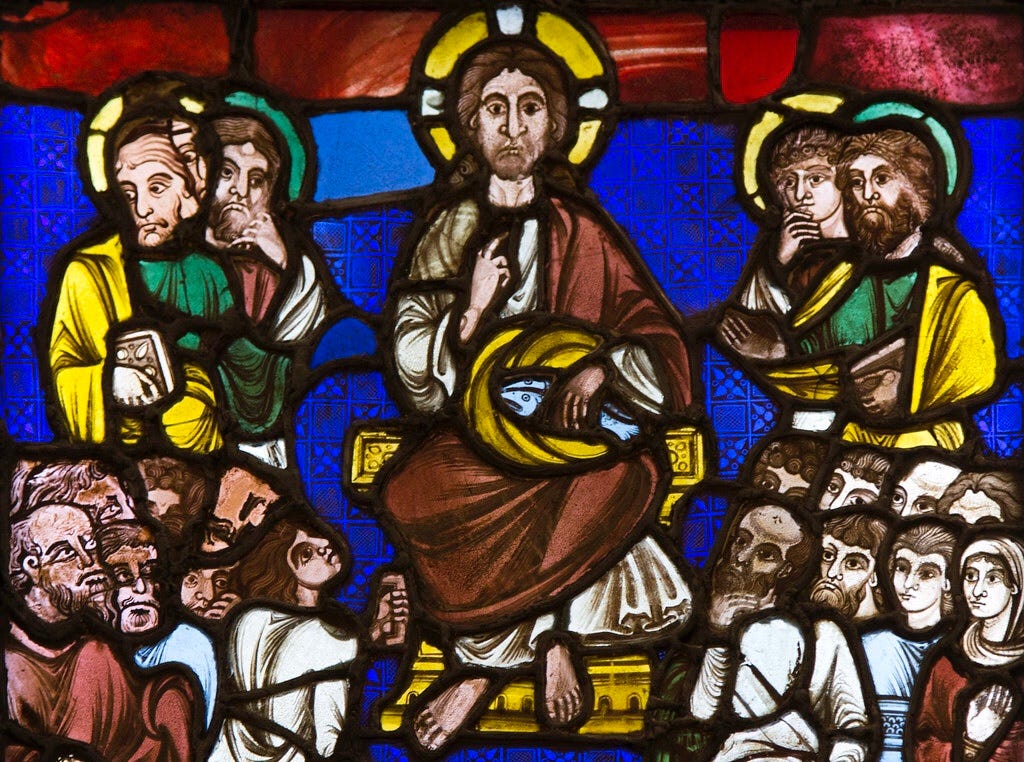
Image Source: Fr Lawrence Lew OP (Creator), Jesus feeds the Five Thousand, Detail from a medieval stained glass window in the Victoria & Albert Museum, London., Flickr, CC BY-NC-ND 2.0
Suggested Reading:
Arbuckle, G.A. (2013). Catholic identity or identities? Rebounding ministries in chaotic times. Liturgical Press.
Burr, V. (1993). Social constructionism (2nd edition). Routledge.
Scott, S. (2015). Negotiating identity: Symbolic interactionist approaches to social identity. Polity Press.