

Introduction
I remember being taught that there is no salvation outside the Church, but I rejected this because my father never went to Church, yet he was always a loving father to me. I never accepted that God would not save him.
Every Sunday in the last years of his life, he drove my Mum to Mass and sat in the car with a copy of the Sunday Times. So close, yet so far? And unlike the Canaanite woman you will meet in the Gospel. She knew that Jesus had the power to heal her daughter … and she was not a Jew.
Not long before he passed away, he expressed the desire to become a Catholic. His parents had been members of the Church of England and had their children christened. In the end, he never followed through with that desire. I guess he was finding life difficult and death caught him unawares, I think.
It is an easy trap for a westerner like me to think in a legalistic way about salvation. A short visit to Lumen Gentium made me stop and reflect on the power and beauty of encountering Jesus. And I think about the experience of receiving him when I go to Communion. I have adopted the practice of thanking him for welcoming me into his Body. And I regularly ask God to make sure He has welcomed my Dad into His heavenly kingdom.
The Gospel
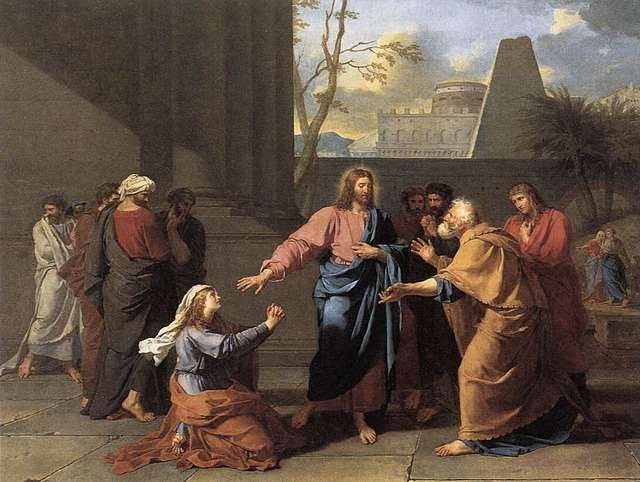
Jesus left Gennesaret and withdrew to the region of Tyre and Sidon. Then out came a Canaanite woman from that district and started shouting, ‘Sir, Son of David, take pity on me. My daughter is tormented by a devil.’ But he answered her not a word. And his disciples went and pleaded with him. ‘Give her what she wants,’ they said ‘because she is shouting after us.’ He said in reply, ‘I was sent only to the lost sheep of the House of Israel.’ But the woman had come up and was kneeling at his feet. ‘Lord,’ she said ‘help me.’ He replied, ‘It is not fair to take the children’s food and throw it to the house-dogs.’ She retorted, ‘Ah yes, sir; but even house-dogs can eat the scraps that fall from their master’s table.’ Then Jesus answered her, ‘Woman, you have great faith. Let your wish be granted.’ And from that moment her daughter was well again. (Matthew 15:21-28)
The Enquiry
See
Follow the storyline presented in this Gospel passage. What do you learn about Jesus and his mission? How does this fit with your experience of Church?
What happens in the life of the Canaanite woman because she reaches out to Jesus for help? What does this tell you about the impact of faith in a person’s life?
Why does the Canaanite woman persist in her interaction with Jesus? How is this story about the relevance of Church? Or your experience of Church?
Judge
What do you make of the reaction of the disciples to the presence of a foreigner shouting at Jesus and kneeling in front of him? What does this tell you about human motives and God’s mercy?
My parish priest always begins his introduction to the Mass by welcoming those who are passing through. Consider the contrast between his attitude and the attitude displayed by Jesus’ disciples in this Gospel story. What have you realised about the attitude ofh Jesus towards the Canaanite woman?
Does Jesus continue to interact with you even when you reject his invitation to follow him on the journey to Calvary? How real is his interaction with you? Do you persist in your prayer for help? Or do you give in to despair?
Act
What have you observed in this Gospel story that is needed in the world and/or in your life?
What small action can you carry out that will contribute to bringing about this transformation of the world and yourself?
Who can you involve in your action, when, where and how often?
Image Source: Jean Germain Drouais (Creator), French painting of the woman of Canaan at the feet of Christ (1784)(, Picryl, PDM 1.0
Worth reading: Lumen Gentium, even if you just read Chapter 1: The Mystery of the Church.