

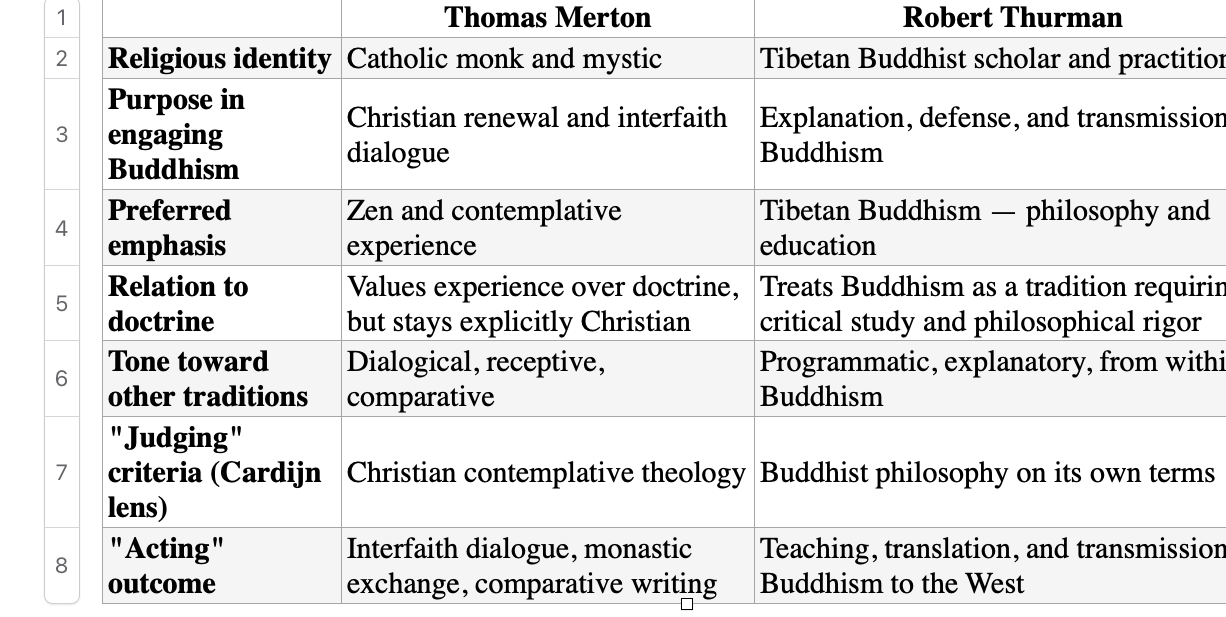
Thomas Merton and Robert Thurman never set out to do the same thing with Buddhism — but they both took it dead seriously. Neither treated it as an exotic curiosity to be studied from a safe academic distance. Both believed it had something real to offer a Western world they saw as spiritually distracted and materially overfed. Where they parted ways was in their stance: Merton approached Buddhism as a Christian monk seeking dialogue and renewal, while Thurman approached it as a Buddhist scholar-practitioner, explaining and defending the tradition from within.
What They Shared
Both men agreed on something easy to miss: Buddhism isn’t primarily a set of ideas to argue about — it’s a path of inner transformation. Merton kept circling back to contemplation, awakening, simplicity, and a critique of modern materialism. Thurman, for his part, frames Buddhism as a rigorous educational tradition aimed at freeing people from ignorance and suffering.
They also agreed that experience matters more than abstract doctrine. Merton believed the deepest meeting point between Christianity and Buddhism wasn’t theology but contemplative experience itself — the “ineffable” reality that sits behind all our words about it. Thurman makes a parallel move, but from a different angle: he emphasizes clear thinking, critical scrutiny, and direct experiential insight over simple belief.
Merton’s Lens: A Christian in Dialogue
Merton’s interest in Buddhism was, at its core, interreligious and Christ-centered. He studied Zen more intensely than any other Buddhist school, found striking parallels between Zen and Christian contemplative practice, and borrowed Buddhist vocabulary — emptiness, no-self, awakening — not to replace his Christian faith but to deepen it.
Buddhism also gave Merton a mirror to hold up to the West. He admired its simplicity, its silence, its knack for cutting straight through illusion, and he hoped Christian monks could learn from Buddhist monastic discipline without ever stepping outside the Christian faith.
Thurman’s Lens: A Buddhist Teaching Buddhism
Thurman’s posture is different — he writes and teaches from inside the tradition. He presents Buddhism as an analytical, educational, and liberating system that deserves to be studied critically and practiced seriously, usually framed by the philosophical and contemplative depth of Tibetan Buddhism in particular.
He’s also more pointed in his critique of modernity. Thurman argues that Buddhism offers tools — mental discipline, education, freedom from suffering — that secular culture has largely neglected. Where Merton stays modest and dialogical, Thurman teaches Buddhism as a complete worldview, with confident claims of its own.
A Third Voice: Joseph Cardijn and the See-Judge-Act Method
There’s a useful frame for reading both men that comes from a very different corner of twentieth-century Catholicism: Joseph Cardijn, the Belgian priest who founded the Young Christian Workers movement and helped popularize what’s known as the See-Judge-Act method.
Cardijn’s method was simple but radical for its time. Instead of starting from abstract doctrine and applying it downward to life, he insisted that authentic faith and authentic action had to start from concrete reality:
See — look honestly at the actual conditions of life, without filtering them through pre-formed conclusions.
Judge — reflect on what you’ve seen in light of your deepest values and convictions, asking what it means and what it demands.
Act — respond concretely, in a way that’s grounded in both the seeing and the judging, rather than in theory alone.
Cardijn developed this for young workers trying to live out their faith amid industrial labor conditions that the institutional Church often ignored. But the method generalizes well beyond labor activism — it’s really a discipline for how contemplation and conviction are supposed to meet the world, rather than remain sealed off from it.
Why this matters for Merton and Thurman:
Both men, in their own ways, were doing a version of See-Judge-Act with Buddhism itself.
Merton “saw” Buddhism with real attentiveness — its silence, its practices, its monastic discipline — refusing to dismiss it from a position of Christian superiority. He “judged” what he saw through his Christian contemplative convictions, asking what it meant for his own tradition. And he “acted” by pursuing dialogue, writing, and even traveling to Asia to meet Buddhist teachers directly — a journey cut short by his death in 1968.
Thurman “saw” Buddhism by immersing himself in it directly, becoming a monk and scholar within the Tibetan tradition rather than observing from outside. His “judging” occurs within Buddhist categories rather than by translating them into a different framework. And his “acting” takes the form of teaching, writing, and advocacy aimed at transmitting Buddhism into a modern, largely secular West.
Cardijn’s method also sharpens a question the original comparison leaves a bit soft: where does the “judging” stage actually happen for each man? Merton’s judgment is explicitly Christian — Buddhism gets evaluated and integrated through a Catholic contemplative lens. Thurman’s judgment happens by Buddhist standards he’s already committed to — he isn’t asking “does this fit my prior framework?” because Buddhism is his framework. That’s arguably the single clearest way to state the difference between them: not just what they saw in Buddhism, but which set of criteria they used to judge it, and what action followed from that judgment.
The Bottom Line
Merton asks: how can Buddhism help Christians pray, see more clearly, and live more contemplatively? Thurman asks: how can Buddhism be understood, taught, and practiced as Buddhism, here and now?
Their overlap is real — both prize direct experience, compassion, and freedom from illusion. But their starting points couldn’t be more different. Merton is a Christian in conversation with Buddhism. Thurman is a Buddhist speaking Buddhism’s own language to a modern audience. Run both of them through Cardijn’s See-Judge-Act method, and the difference gets even crisper: they may have seen similar things in Buddhist practice, but they judged those things by different lights entirely — and so they acted in very different directions.
Something to Sit With
Can someone borrow deeply from another tradition’s language and practice — as Merton did with Zen — without ever leaving their own faith behind?
Does Thurman’s “inside” approach make Buddhism more authentically transmitted, or does Merton’s “outside” curiosity make it more accessible to people who’d never otherwise encounter it?
If Merton had lived past 1968, would his dialogue with Buddhism have stayed comparative — or might he have drifted closer to Thurman’s more committed practice?
Using Cardijn’s framework, is it possible to truly “see” another tradition clearly if your “judging” criteria are already fixed in advance, and does that limitation apply equally to Merton and Thurman, or more to one than the other?
Is there a real difference between practicing a tradition critically from within and appreciating it contemplatively from without — or is that distinction less clean than it looks?