

Introduction
We celebrate the Feast of the Most Holy Body and Blood of Christ on this day. Often known as “Corpus Christi,” the feast is celebrated in many places around the world with much joy and with processions. And no wonder: it is the celebration of the Real Presence of Christ in the Eucharist.
I have always believed in the presence of Christ in the Eucharist and I cherish that brief moment after receiving Holy Communion at Mass when I am united with him and with all who profess belief in him as the Son of God.
The Pastoral Constitution on the Church in the Modern World (Gaudium et Spes) was the final document promulgated at end of the Second Vatican Council. In Chapter Three, which reflects on the human experience, “namely, that the great advantages of human progress are fraught with grave temptations” (GS 37), can be found a statement worthy of reflection by those who engage in this Gospel Enquiry:
The Lord left behind a pledge of this hope and strength for life’s journey in that sacrament of faith where natural elements refined by man are gloriously changed into His Body and Blood, providing a meal of brotherly solidarity and a foretaste of the heavenly banquet (GS, 38).
The “hope and strength” the Council Fathers refer to in this statement can be found in the promise Jesus makes to all who accept him as “the living bread which has come down from heaven.”
The Gospel
Jesus said to the crowd: ‘I am the living bread which has come down from heaven. Anyone who eats this bread will live for ever; and the bread that I shall give is my flesh, for the life of the world.’
Then the Jews started arguing with one another: ‘How can this man give us his flesh to eat?’ they said.
Jesus replied: ‘I tell you most solemnly, if you do not eat the flesh of the Son of Man and drink his blood, you will not have life in you. Anyone who does eat my flesh and drink my blood has eternal life, and I shall raise him up on the last day.
‘For my flesh is real food and my blood is real drink. He who eats my flesh and drinks my blood lives in me and I live in him. As I, who am sent by the living Father, myself draw life from the Father, so whoever eats me will draw life from me.
‘This is the bread come down from heaven; not like the bread our ancestors ate: they are dead, but anyone who eats this bread will live for ever.’ (John 6:51-58)
The Enquiry
See
What does Jesus say about life, death and eternal life? What is the significance of his references to flesh and blood, to eating and drinking, and to bread?
How have Jesus’ words about his flesh and blood impacted the world?
Why was there a need for Jesus to speak to his followers in this way?
Judge
Where does Jesus fit into your view of the world? Is he “the living bread … from heaven” in your life?
If you are committed to following Jesus, how is your life different because of your commitment to him?
What do you find challenging about Jesus’ message to those who gathered to listen to him?
Act
Prompted by what Jesus says in this Gospel, what are you being called to change in your life and in the world?
What small action can you carry out that will contribute to bringing about the change that God wants to see in you and in the world?
Who can you involve in your action, when, where and how often?
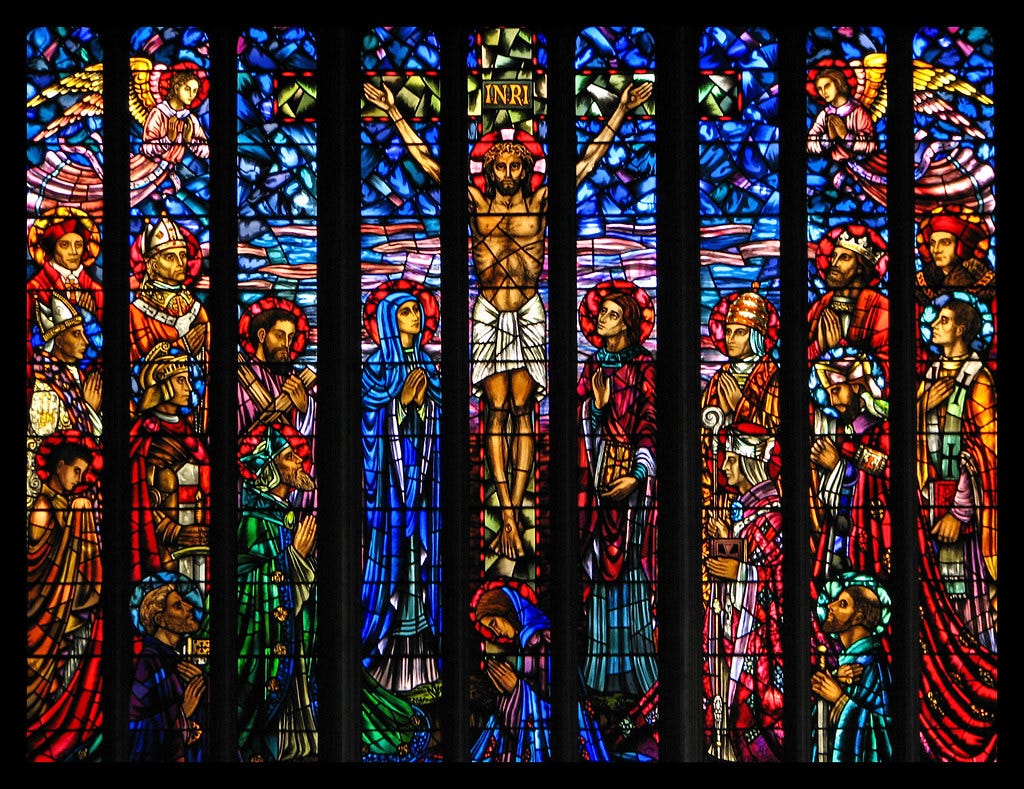
Image Source: Lawrence Lew OP (Creator), Saints around the Cross (part of the east window of St George’s Cathedral, Southwark - stained glass prepared by Harry Clarke),.Flickr, CC BY-NC 2.0
There is something really interesting about people having their AHA moment, when the understanding of real presence clicks. For starters, they are, for the most part, adults. It comes as a sudden realization of being one with God, and people say they can't put their finger on why it happened, but it did. When you talk with them, they will say, "I grew up thinking and knowing it, but I could take it or leave it; then one day it all clicked." And when that happens, the next step is an understanding of community.
It is why adult education is so valuable, why community is important, and why it is necessary to be present when others have that AHA moment.