

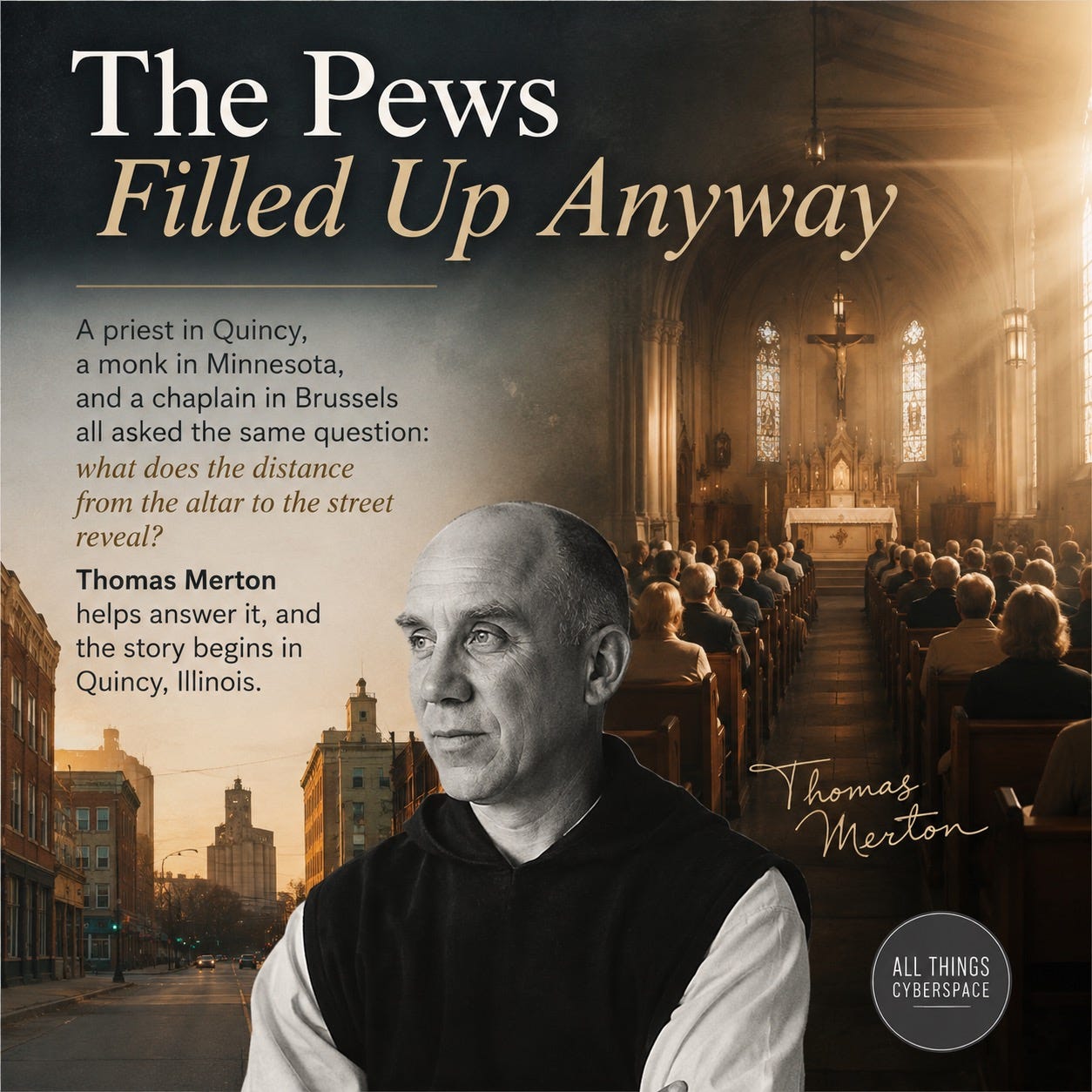
A priest in Quincy, a monk in Minnesota, and a chaplain in Brussels all asked the same question: what does the distance from the altar to the street reveal? Thomas Merton helps answer it, and the story begins in Quincy, Illinois.
In the summer of 1886, a thirty-two-year-old priest stood upon the altar of St. Joseph’s in Quincy, Illinois, and watched a congregation that was not supposed to be there.
The parish was set up for the town’s Black Catholics, and everyone knew it was supposed to be that way. But the priest’s preaching was so powerful that people talked about it, and soon German and Irish families started coming from other parishes to sit with those they had been separated from. No one planned this. It just kept happening because his sermons were that good.
His name was Augustus Tolton. He had been born into slavery on 1 April 1854 at Brush Creek, in Ralls County, Missouri. His father escaped to join the Union Army and died of dysentery in a military hospital. His mother took her children across the Mississippi at night into Illinois. When Tolton asked to study for the priesthood, no seminary in the United States would admit him. Not one. His pastors tutored him until the Franciscans in Quincy accepted him as a special student, and in 1880 they sent him to the Urban College of Propaganda Fide in Rome. He was ordained on 24 April 1886 at St. John Lateran and said his first Mass at St. Peter’s.
He expected to be sent to Africa. Every student at Propaganda Fide trained for an overseas mission, and he spent six years learning African languages. But Cardinal Giovanni Simeoni sent him back to Illinois, saying that America claimed to be the most enlightened nation and, “we will see if it deserves that honor.”
The answer came within three years. Father Michael Weiss, the dean of Quincy, disliked the large crowds and told Tolton to serve only Black Catholics. The church was full, and that was the problem. So in 1889, Tolton moved to Chicago, brought together about fifty Black Catholic families in the basement of Old St. Mary’s, and started building St. Monica’s on the South Side. He died of heat stroke on 9 July 1897, at age forty-three, before the Church was finished.
In Quincy, the liturgy did exactly what the Church says it should do: it brought together people society usually kept apart, and made that result visible.
Yet the Church saw this gathering as a problem to be managed, not as proof of what worship was doing.
The syllogism from Collegeville
Forty-six years later, a Benedictine at St. John’s Abbey in Collegeville, Minnesota, wrote down the reason this matters in three lines.
Virgil Michel (1890–1938) went to Europe in 1924, met Lambert Beauduin, and came home convinced that American Catholicism was starving on a diet of private devotion. In1926,6 he founded the journal Orate Fratres, now called Worship, and the Liturgical Press. He argued that the Mass is not a ceremony individuals attend but the act of a body to which they belong, and that people formed by such an act cannot leave it unchanged.
In 1935, closing an article in Orate Fratres titled “The Liturgy the Basis of Social Regeneration,” he put it as a syllogism. Pius X had taught that the liturgy is the indispensable source of the true Christian spirit. Pius XI had taught that the true Christian spirit is indispensable for rebuilding society. Therefore, Michel concluded, “the liturgy is the indispensable basis of Christian social regeneration.”
Read the argument the other way around, and it becomes a test instead of just a slogan. If a parish’s worship doesn’t lead to social change, then something is missing in one of the two main ideas.
Michel was not afraid to point out where things had gone wrong. In 1937, he listed the injustices that American Catholics ignored: sharecroppers, the courts, economic oppression, vigilante violence, and how Black Americans were treated “even at times within the walls of Catholic churches.” He was thinking of Tolton’s experience and even worse cases. Michel died in November 1938 at age forty-eight, having seen little of the change he hoped for.
Michel also put his beliefs into action. He supported Dorothy Day and Peter Maurin, who started the Catholic Worker in 1933. He sent them books from the Liturgical Press and introduced them to the Liturgy of the Hours. He also advocated for using local languages in worship and women in lay leadership, long before these ideas became common.
The method that came from a coal deliverer’s son
Joseph Cardijn (1882–1967) grew up in Halle, helping his father deliver coal, and blamed the man’s early death on the conditions he worked in. Ordained in 1906, he watched his old schoolmates go into the mines and mills and concluded that the Church had left them there.
What he built in response was not a charity. It was a formation method that treated workers as the agents of their own conversion of the world. With collaborators including Victoire Cappe and Fernand Tonnet, he refined an approach over roughly twenty years, drawing on the Sillon movement he had studied in France as a seminarian. The Young Trade Unionists became the Jeunesse Ouvrière Chrétienne, the Young Christian Workers, holding its first congress on 18 April 1925 after Pius XI overrode the hesitations of the Belgian hierarchy. Paul VI made Cardijn a cardinal in February 1965, and he addressed the Second Vatican Council as an expert that same year.
The method fits on an index card:
See the concrete reality, in detail, as it actually is. Judge it against the Gospel and the Church’s social tradition. Act to change what is unjust and strengthen what is good.
Each of these three steps is a practice. Seeing means looking at the real factory, the real wage, the real parish. Judging means comparing what you see to a standard beyond your own opinion. Acting means doing what you might have been avoiding, moving from discernment to change.
This method is like the Mass in a different form: it moves from hearing to offering to being sent, so the pattern stays visible.
The people hear the Word, offer the world, receive Christ, and are sent out. John XXIII included these three steps in Mater et Magistra in 1961, and the second half of Gaudium et Spes followed the same pattern four years later. What began as a chaplain’s method for young factory workers became the basic approach of Catholic social teaching.
That teaching has a documented spine, and the dates are worth keeping straight: Rerum Novarum (Leo XIII, 1891) on the dignity of labor and the rights of workers; Quadragesimo Anno (Pius XI, 1931) on subsidiarity and social order; Mater et Magistra (John XXIII, 1961); Pacem in Terris (John XXIII, 1963) on rights, duties, and peace; Gaudium et Spes (Vatican II, 1965), which opens by claiming the griefs of the poor as the griefs of Christ’s disciples. None of these is a political manifesto. Each tries to say what the Gospel requires under conditions the Gospel’s first hearers never faced.
One essence, three persons, and who sits at the table
The theological ground of all this was laid in Cappadocia in the fourth century, and the standard account leaves out the person who taught most of it.
Macrina the Younger belongs at the front of the list with her brothers Basil of Caesarea and Gregory of Nyssa and their friend Gregory of Nazianzus. Gregory of Nyssa wrote her life and cast her as the teacher in On the Soul and the Resurrection, where she questions him from her deathbed, in the role Plato gave Socrates. She turned the family estate into a community where servants and mistresses ate at the same table.
Theological ground for all this was laid in Cappadocia in the fourth century, and the standard account leaves out the person who taught most of it.
Both brothers drew the consequences in public. When the rains failed, and famine hit Caesarea in 368, Basil spent his inheritance, preached against the speculators holding grain for a better price, and built a complex outside the walls with wards, physicians, a hospice, and workshops, which historians often call the first hospital in the Western world. Around 379, preaching his fourth homily on Ecclesiastes, Gregory of Nyssa reached the verse about buying enslaved people and did what no surviving writer of antiquity had done: he condemned the institution itself. What price, he demanded, did you put on rationality? Nothing in existence is worth as much as a human being, because a human being carries the likeness of God, and no one holds title to that.
Fifteen hundred years later, the American Church recited the Nicene Creed every Sunday but still could not find a seminary willing to accept Augustus Tolton. That contradiction is the problem this essay keeps returning to. The throughline held, even when the institution did not.
Merton’s mirror
Thomas Merton wrote “Letters to a White Liberal” in the early summer of 1963, months after Martin Luther King Jr.’s letter from the Birmingham jail. It was published in 1964 as the opening essay of Seeds of Destruction (New York: Farrar, Straus and Giroux).
When Merton said “white liberal,” he did not mean a political group. He meant any white person, especially white Christians, who thought good intentions were enough. He argued that racism in the United States was built into the system, and that white Americans benefited from it whether they liked it or not. Many did not want to see this. For Merton, contemplation was not a way to avoid this truth; instead, it was the practice that made seeing it possible, because prayer that does not change how you see things is just another way of looking away.
He also made it clear that Black Americans were responsible for their own liberation, not just recipients of help from white people. This strongly challenges a certain kind of Catholic charity, and keeps the argument focused on agency.
Paternalism lets the giver stay in control, but real solidarity does not. This is the distinction the essay uses to judge the examples it has gathered.
The strongest objection
Here is the case against everything above, made as its own defenders would make it.
The liturgy is about worshiping God. It is not meant to be a tool or a program. When a community starts focusing on the social results the Mass produces, it risks using God for its own purposes, and eventually those purposes can take God’s place. In the twentieth century, many parishes used the liturgy to push their own politics, and the sense of the sacred faded. Worship is not valuable because of what it produces, and if the Church forgets this, it has nothing to offer the poor that a regular charity could not do better.
This objection is important, and both Michel and Merton agree with its main point. Michel’s argument does not claim that the liturgy exists to create social change. Instead, it says the liturgy shapes the Christian spirit, and that spirit is what leads to social renewal. The order is important. Worship is beyond a tool; it is something that gives life. Merton makes a similar point: if contemplation is used only to create activists, it is not true contemplation.
This brings the argument back to its main point.
The claim is not that liturgy should be used for justice. The claim is that truly receiving the Eucharist changes people so they cannot remain indifferent. If this does not happen, then something is wrong at a deeper level.
Read that again and let it sink in.
What follows
Five propositions, short enough to keep.
Worship is not private. The Mass forms a body, and a body has a public.
Structures are the field of the test. “I personally do not hate anyone” is a statement about feelings. Justice is a statement about who we are. Look closely before you judge: the actual wage, the actual parish, the actual street. Speaking in general terms lets everyone avoid responsibility.
Difference is not a defect. Unity without erasure is the shape of God’s own life, and the standard for any community claiming to reflect it.
Charity that preserves your position is not solidarity. Merton’s line, and it costs something every time.
The American bishops have said this in their own voice twice. Brothers and Sisters to Us (1979) stated plainly that racism is a sin, one that divides the human family and blots out God’s image in its members. Open Wide Our Hearts: The Continuing Call to Love (2018) said it again, adding that too many institutions still harbor practices that deny justice, and passed 241 to 3. The bishops’ own catechetical materials on racism call the liturgy a sign and instrument of communion, and the Eucharist the sacrament of oneness. Those are strong words. They were true in Quincy in 1888, and they had no institutional force there.
The pews at St. Joseph’s filled up with the wrong people, and the Church of that time and place experienced this as a crisis rather than as an answered prayer. Tolton went north, gathered fifty families in a basement, and was still building the Church when the heat killed him.
The dismissal at the end of Mass is not a courtesy. It is an order.
Questions Worth Sitting With, Using the See–Judge–Act Method
Father Weiss did not object to the Mass. He objected to who came. Where does your own community welcome people in principle while quietly managing who actually shows up?
Michel’s test runs backward as well as forward: if the worship produces no social consequence, a premise has failed. Apply it to your parish this year. What has changed on the street because of what happens at that altar?
Cardijn’s first verb is see, and it is the one most often skipped. Name one concrete condition in your workplace or neighborhood that you have never actually looked at closely. What has kept you from looking?
Gregory of Nyssa asked the slaveholder what price he had put on rationality. What do we currently price that a later generation will find indefensible?
Merton argued that good intentions are not the point, because benefit does not require approval. Where do you benefit from an arrangement you would say you oppose?
Tolton spent six years learning African languages for a mission he was never sent on, and was then told to serve only his own. Who in your community is being trained for a role you have already decided not to give them?
Sources
Virgil Michel, OSB, “The Liturgy the Basis of Social Regeneration,” Orate Fratres 9 (1935): 536–545; reprinted in The Social Question: Essays on Capitalism and Christianity (Collegeville: St. John’s University, 1987).
Paul Marx, OSB, Virgil Michel and the Liturgical Movement (Collegeville: The Liturgical Press, 1957).
Thomas Merton, Seeds of Destruction (New York: Farrar, Straus and Giroux, 1964).
David Bentley Hart, “The ‘Whole Humanity’: Gregory of Nyssa’s Critique of Slavery in Light of His Eschatology,” Scottish Journal of Theology 54, no. 1 (February 2001): 51–69.
Gregory of Nyssa, Fourth Homily on Ecclesiastes, c. 379.
United States Conference of Catholic Bishops, Brothers and Sisters to Us (1979) and Open Wide Our Hearts: The Enduring Call to Love (2018).
Leo XIII, Rerum Novarum (1891); Pius XI, Quadragesimo Anno (1931); John XXIII, Mater et Magistra (1961) and Pacem in Terris (1963); Second Vatican Council, Gaudium et Spes (1965).
Archdiocese of Chicago, Father Augustus Tolton canonization cause materials; Missouri Encyclopedia, “Augustus Tolton (1854–1897).”
Joseph Cardijn Digital Library and the Australian Cardijn Institute, on the JOC and the See–Judge–Act method.
Nota Bene: I write for people of any faith or none. For the family sitting in the pew on a Sunday morning with kids who really don’t want to be there.
The See–Judge–Act framework is gratefully borrowed from Joseph Cardijn.