

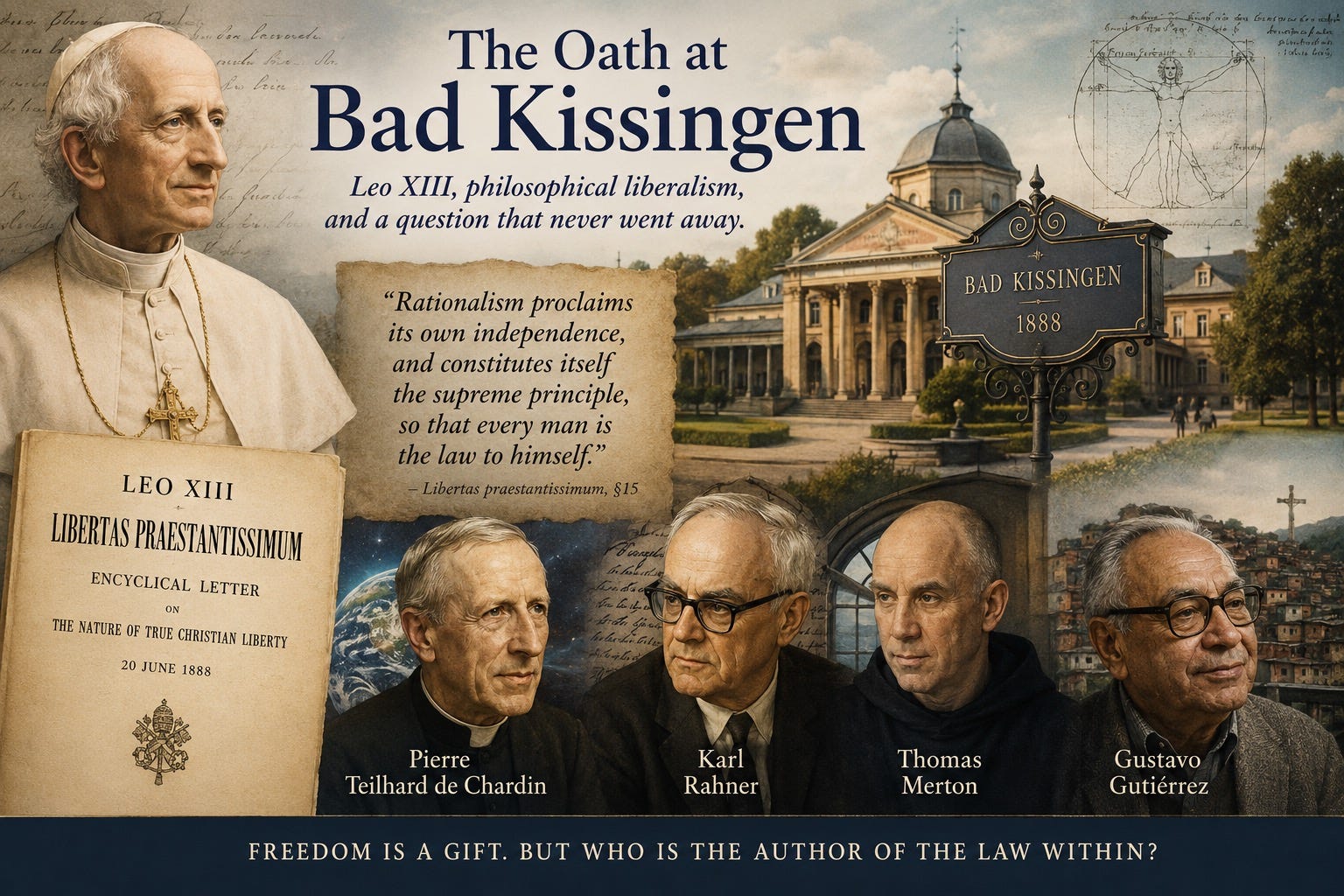
Leo XIII, philosophical liberalism, and a question that never went away.
The order was unmistakable, and everyone expected him to obey. He was summoned to the barracks at Bad Kissingen, where he was to raise his right hand and recite the oath. His religious superiors pressed him to comply. When he refused, they threatened to expel him from the Society. Later, in Tegel prison, a Catholic chaplain withheld communion, declaring that anyone who shirked his duty had no place at the altar.
He arrived on 15 April 1942 and stood firm: he would not swear the oath.
His name was Franz Reinisch. He was thirty-nine, born in Feldkirch on 1 February 1903, and ordained in Innsbruck on 29 June 1928. He was a Pallottine priest, and since 12 September 1940, the Reich had banned him from preaching or speaking in public. He did not refuse to serve. He said he was willing to serve Germany or any government, even to carry a stretcher if needed. But he would not give unconditional loyalty to Adolf Hitler. “There must be people,” he said, “who are protesting against the abuse of authority, and I feel called to this protest.”
A military court sentenced him to death on 7 July 1942, for undermining military morale. Guards took him to Brandenburg-Görden, where he was beheaded at 5:03 in the morning on 21 August 1942. His body was cremated. He was the only Catholic priest in the Third Reich who refused his call-up order, and the only priest executed for it. The diocesan phase of his cause began in Trier on 28 May 2013, and ended on 28 June 2019.
It is important to see what Reinisch was not doing: he was not making a stand for personal autonomy.
He never claimed the right to act as he pleased, nor did he pretend his conscience was his own invention. On the contrary, he insisted that a higher authority—one he neither created nor could alter—had already claimed him. The state and his superiors alike were answerable to this authority. Both ordered him to swear the oath, but he answered that neither could speak the final word.
At its heart, this question concerns the true source of authority over a person. More than half a century earlier, a pope tackled this very issue in an encyclical now largely forgotten.
The Encyclical Nobody Quotes
On 20 June 1888, Leo XIII released Libertas praestantissimum. Though it is the least discussed of his writings, it quietly underpins all the rest.
Leo was not attacking freedom itself. He called liberty one of the greatest natural gifts and began by defending free will against determinism. His real target was the idea that the human will is the highest authority. He stated this clearly. Rationalism, he wrote, “proclaims its own independence, and constitutes itself the supreme principle,” so that “every man is the law to himself” (§15).
He responded with a two-part argument. Freedom is a capacity, and every capacity has a purpose. The purpose of a rational will is the good that reason can recognize. Law is not just a limit on freedom; it describes what freedom is meant for. “In man’s free will,” he writes, “or in the moral necessity of our voluntary acts being in accordance with reason, lies the very root of the necessity of law” (§7).
In practical terms, Leo’s point is stark. If nothing is true about a person before they choose, then choices are never wrong, only unsuccessful. If no choice can be wrong, then every conflict becomes a contest of power.
When freedom is treated as the highest value, only the strongest freedom prevails. Leo was not simply defending authority over freedom; he was probing what keeps authority from collapsing into mere power.
Franz Reinisch confronted this question in its most brutal form. A state that recognized no truth above its own will demanded absolute loyalty to a single man, executing those who refused. Pure autonomy cannot explain why Reinisch was right; in that framework, he was merely one preference pitted against the machinery of law and religious authority.
The Bill of Indictment
Serious arguments run against reviving Leo’s ideas, and they deserve to be faced head-on, not brushed aside.
First, Leo did not stop at the metaphysics. Libertas draws political conclusions from it. Liberty of worship, of the press, and of teaching are treated as concessions the state may tolerate to avoid a greater evil, not as rights the person holds (§§20, 23, 24, 33). The doctrine that error has no rights was not a caricature invented by Leo’s opponents. It was the working principle.
Second, the institution making the argument had a record. On 20 June 1859, twenty-nine years to the day before Libertas, papal troops under Colonel Anton Schmid retook Perugia from its provisional government and sacked parts of the city. Around twenty-seven Perugians died. The bishop of Perugia at the time was Gioacchino Pecci, the future Leo XIII. A hierarchy that insists freedom must answer to truth, while holding the instruments of coercion, faces an obvious temptation, and Catholic history offers plenty of examples of the Church yielding to it.
Third, the Church itself revised the political half of Leo’s teaching. Dignitatis humanae, promulgated on 7 December 1965, holds that the human person has a right to immunity from coercion in religious matters, and grounds that right in the dignity of the person rather than in the truth of the person’s opinions. Whether this is development or reversal has been argued for sixty years. What is not arguable is that the practical program attached to Libertas did not survive.
So the real question is not just whether Leo was right, but whether his deeper philosophical claim endures now that the political structure built on it has crumbled.
Pierre Teilhard de Chardin spent his working life under restriction. His superiors removed him from teaching in Paris and sent him to China in the 1920s after a private paper on original sin circulated. He was forbidden to publish his religious and philosophical work; Le Phénomène humain appeared only after his death on 10 April 1955. The Holy Office issued a monitum on 30 June 1962 warning against the ambiguities in his writings.
Teilhard is often labeled an optimist, but that misses his complexity. His real insight lies in where he locates the standard: for him, the truth that binds a person is not a static rule imposed from outside history, but the very direction of creation, moving toward Christ. Authority emerges from within reality itself, not imposed upon it.
The main objection is obvious: a standard still unfolding cannot guide anyone in the present, and Reinisch did not have eternity to decide. Teilhard replies that reality does not lose its force just because it is unfinished. A river’s course is still real, even as it moves.
In any case, Teilhard does not champion autonomy. He places the source of authority even farther from human choice, not nearer.
The Grace That Arrives Before the Command
Karl Rahner best illuminates Reinisch’s stance.
Rahner’s doctoral thesis in philosophy was rejected at Freiburg for leaning too far toward Heidegger; it was published as Geist in Welt in 1939 and eventually honored with a doctorate at Innsbruck in 1973. In 1962 his superiors informed him that Rome had placed him under pre-censorship: no publishing, no lecturing without prior permission. That same year, John XXIII named him a peritus at the Second Vatican Council, where he became one of the theologians shaping Lumen gentium.
His main idea, called the supernatural existential, says that God’s self-communication is already present in every person before any religious act, command, or hearing of the Gospel. Grace is not something added to a neutral being; it is the condition in which every person already exists.
This idea has two consequences. First, it rules out autonomy, since a relationship they never chose shapes every person. Second, it denies that authority comes only through official channels, because the truth that binds a person is discovered within and can be recognized personally. His superiors had real authority, but they were not its source. When they told him to swear the oath, he could respond from within the same tradition that shaped them, and he was not just following his own preference.
Freedom Is Not Only Non-Interference
Gustavo Gutiérrez published Teología de la liberación: Perspectivas in Lima in 1971. The Congregation for the Doctrine of the Faith responded twice: Libertatis nuntius on 6 August 1984, warning against borrowings from Marxist analysis, and Libertatis conscientia on 22 March 1986, affirming the aspiration to liberation as authentically Christian.
Liberation theology, when set beside Libertas, is not Leo’s opposite. Instead, it borrows Leo’s argument and turns it toward a different question—one Leo largely left aside.
Leo challenged political liberalism, which holds the will of the citizen or the state as the highest law. Gutiérrez challenged economic liberalism, which insists that any freely made contract is justified by its freedom. Both contend that a freely chosen arrangement can still be unjust, because something true about the human person exists before any agreement. For instance, a wage accepted out of desperation is not necessarily fair. That principle could be lifted straight from Rerum Novarum—and indeed, it is.
The real concern of the 1984 instruction was both different and crucial: a system that explains everything through class conflict risks eroding the very idea of the person it aims to defend, leaving individuals at the mercy of whoever prevails. This is Leo’s warning, echoed in a new key.
The Monk Who Was Told to Stop Writing About Peace
On 26 April 1962, Thomas Merton received a letter from Dom Gabriel Sortais, the Abbot General of his order, forbidding him to write further about war and Peace. The manuscript of Peace in the Post-Christian Era was ready. Orbis Books did not publish it until 2004. Merton’s Cold War Letters, written between October 1961 and October 1962, went out to Jim Forest, Dorothy Day, Daniel Berrigan and others in mimeograph. “The orders are, no more writing about peace,” he wrote to Forest. “This is transparently arbitrary and uncomprehending.”
He obeyed the order, yet he kept writing. That tension—obedience and persistence—is his main legacy to this debate.
Merton devoted his life to exploring the idea of the false self—the self constructed, defended, and mistaken for personal preference. In his spiritual journey, he sought to dismantle this false self, which philosophical liberalism elevates to the center of politics. For Merton, the autonomous self is not just a fragile political notion; it is an illusion that breeds unhappiness. The aim of contemplation is to release it.
This is why Merton, rather than Leo, speaks to our time. Leo answers in the language of law and metaphysics, which Today often sounds like an institution guarding its privileges. Merton responds in the language of lived experience: you did not create yourself, you are not your preferences, and what truly holds authority over you is found in silence, not imposed by decree.
The Load-Bearing Wall
In this way, the whole argument enters Catholic Social Teaching, stepping out of the realm of academic debate.Community comes first, and it is not earned. Leo XIV writes in Magnifica humanitas, signed on 15 May 2026, that human dignity “is neither acquired nor earned, nor does it need to be justified” (§53). If autonomy were the ground of dignity, then dignity would scale with the capacity to choose, and the infant, the person with advanced dementia, the prisoner, and the unconscious would hold less of it. Leo XIII’s premise is what keeps that door shut.
The common good rests on more than tallying up everyone’s preferences. Counting preferences yields a majority, but not always what is truly good. Only a deeper truth about the person lets us say the majority can be wrong.
Subsidiarity depends on both sides of the argument. Quadragesimo anno, from 15 May 1931, teaches that a higher authority should not take over what a lower group can handle. This principle makes no sense if you believe only in autonomy, because there would be no way to limit authority, and it also fails under absolutism, because there would be no reason to limit it. It only works if authority is both real and accountable.
Property and contracts are real, but never absolute. Rerum Novarum, from 15 May 1891, upholds private property but insists it must serve the common good. This is Libertas in action for labor contracts: consent is necessary, but never sufficient.
And the warning runs in both directions. John Paul II in Centesimus annus, 1 May 1991, writes that “a democracy without values easily turns into open or thinly disguised totalitarianism,” and in the same paragraph warns against those who “in the name of an ideology which purports to be scientific or religious, claim the right to impose on others their own concept of what is true and good.” Veritatis splendor, 6 August 1993, names the modern error precisely as “the dependence of freedom on truth” being lessened. Today, the question appears in new forms. Magnifica humanitas describes mass data collection and behavioral prediction as “a new form of power” (§171), warns that technology should not be controlled “by only a few people” (§67), and notes that “a more moral AI is not enough if that morality is determined by a few” (§107). Recommendation systems now claim authority over people, using the language of autonomy: your feed, your choices, your preferences—shaped and returned to you by a system that influenced them. Leo XIII would recognize this pattern. When freedom is the highest value, and nothing stands above it, whoever shapes preferences holds the real power. ces governs.
Five Questions to Carry
Who or what is claiming authority over this person right now, and on what grounds does it claim it?
Is the claim answerable to anything, or is it self-justifying?
Would the arrangement still be defended if the person consenting to it had a real alternative?
Does this account of dignity survive when the person cannot choose?
Who benefits from the answer, and would they be willing to say so out loud?
These questions are simple enough to jot down on an index card—and that is their strength. Leo XIII’s question is not merely a doctrine to recite; it is a test to live by.
Reinisch possessed neither power nor influence. He defied a lawful order, faced expulsion from his religious order, was denied communion by a priest, and was executed by a court that followed its own rules. By the logic of pure autonomy, he was simply a loser.
He was not demanding the right to decide for himself. He believed the decision had already been made by an authority that neither the Reich nor the Pallottines could create or erase.
This is the very claim Leo XIII made in 1888, stripped of its political and religious trappings and tested in the crucible of real life. It deserves another look—not to revive an old political program, but because the question beneath it still matters.
Someone still determines what a human being is meant for.
At 5:03 in the morning, Franz Reinisch already knew the answer.
Sources
Leo XIII, Libertas praestantissimum, 20 June 1888 (Vatican; Papal Encyclicals Online).
Leo XIII, Rerum Novarum, 15 May 1891.
Pius XI, Quadragesimo anno, 15 May 1931.
Second Vatican Council, Dignitatis humanae, 7 December 1965.
John Paul II, Centesimus annus, 1 May 1991; Veritatis splendor, 6 August 1993.
Congregation for the Doctrine of the Faith, Libertatis nuntius, 6 August 1984; Libertatis conscientia, 22 March 1986.
Leo XIV, Magnifica humanitas, signed 15 May 2026, published 25 May 2026.
Holy Office, Monitum on the writings of Pierre Teilhard de Chardin, 30 June 1962.
Gustavo Gutiérrez, Teología de la liberación: Perspectivas (Lima: CEP, 1971).
David Rice, I Will Not Serve: The Priest Who Said No to Hitler (Dublin: Mentor Books, 2018).
Thomas Merton, Peace in the Post-Christian Era (Maryknoll: Orbis Books, 2004); Cold War Letters, edited by Christine M. Bochen and William H. Shannon (Maryknoll: Orbis Books, 2006).
A Note on My Blogs:
Nota Bene: I write for people of any faith or none. For the family sitting in the pew on a Sunday morning with kids who really don’t want to be there.
The See–Judge–Act framework is gratefully borrowed from Joseph Cardijn and is central to Catholic Social Teaching.
As a cultural historian, I am grateful for my experience in the Benedictine tradition in college and in the Graduate School of Theology. In Benedictine life, “Ora et labora” means that prayer and work are inseparable.
I am not a professional academic. I am a practitioner who reads. And that is Wisdom Speaking. — someone who applies theological thinking to technology and its consequences.😎