

The Clause and the Wall
In 1894, a Seventh-day Adventist in Sydney was convicted of violating the Sunday laws. The sentence offered two options. Pay the fine or sit in the public stocks for two hours.
The Adventists observed Saturday as their Sabbath and worked on Sundays. That year, they drew about five hundred people to each of two protest meetings at Parramatta Town Hall.
Three years later, in 1897, the Protestant churches of the Australian colonies sought to write God into the constitution of the nation they were about to build. The Council of the Churches in New South Wales launched a petition in March. It asked the preamble to recognize God as the world’s supreme ruler and the source of all law, for each house of Parliament to open with prayer, and for the Governor-General to proclaim days of national thanksgiving and humiliation.
The Adventists responded with their own petition, announced in their newspaper, The Bible Echo, on 29 March 1897. It asked the Federal Convention to keep religion out of the Constitution altogether, and the Convention received it on 6 April. That July, the same paper called the Council of the Churches a “religio-political organization “ and linked the campaign to the National Reform Association in the United States, a body that sought to have the American Constitution declare the nation’s allegiance to Jesus Christ.
On 7 February 1898, a Victorian delegate, Henry Higgins, a lawyer who would later sit on the High Court, said the quiet part aloud. He told the Convention in Melbourne that recognizing God “was not proposed merely out of reverence.” It was proposed for political reasons, influenced by American debates.
He had a case to present. In Church of the Holy Trinity v. United States (1892), the United States Supreme Court had described America as a Christian country. Higgins argued that Congress then relied on that reasoning to order the Chicago exhibition of 1893 closed on Sundays.
His fear was specific. Put God in the preamble, and a court might one day read it as permission for Parliament to legislate on religion, especially on Sunday. On 8 February, his first attempt to forbid such laws died on the voices, without a vote.
On 2 March 1898, the Convention did both. Patrick Glynn of South Australia moved to insert the words “humbly relying on the blessing of Almighty God,” and the motion carried. Later that day, Higgins tried again. By a vote of 25 to 16, the delegates agreed that the Commonwealth could not establish a religion, impose religious observance, or prohibit the free exercise of religion, nor require a religious test for any public office.
Australia has lived with both ever since.
That afternoon in Melbourne holds the whole subject in miniature.
An idea born in the United States crossed the ocean. Local people feared it, borrowed it, and bent it to fit their own institutions. What arrived was neither a copy nor an invention. It was something new, and it remains in the Australian Constitution today.
Four cousins
I chose the United States, Great Britain, Canada, and Australia because they are most closely aligned: a shared language, a shared legal inheritance, and a shared news feed. When an argument crosses a border, it crosses these borders first.
The same story travels to all four. A Christian civilization is under threat from secularism, cultural change, or outsiders, and someone must defend it. Each country then tells the story through its own institutions. As a rough shorthand:
In the United States, the idea has a party.
In Britain, it has a badge.
In Canada, it has a protest.
In Australia, it has a lobby.
The rest of this post expands on those four sentences and corrects them where they are too neat. New Zealand belongs in this company, too. It deserves its own post.
Before the numbers
Start by clarifying what the term does not mean. Christians vote, organize, lobby, and run for office in every democracy. A church that backs a conservative party is not nationalist for that reason, and neither is a voter who cares about religious freedom.
Christian nationalism is narrower. It fuses national identity with Christianity. On this view, the nation is truly Christian. Many will say Christianity deserves a special place in public life. Drifting from that tradition threatens the nation itself. Nick Spencer of the British think tank Theos reduces it to a test of belonging: do you have to be Christian to be truly British or truly American? Scholars still debate where to draw the line, and the argument grows harder to draw across borders.
The word “rise“ needs the same care. It can mean more believers, louder ones, or those closer to power. Those are three different stories, and they do not always move together. In May 2026, the sociologist Andrew Whitehead told a Theos podcast that fewer Americans strongly embrace Christian nationalism than before, even as its rhetoric has spread and people in powerful seats now voice it.
Where the idea has a party
The United States stands out for a simple reason. A large religious constituency overlaps with the governing party.
The Public Religion Research Institute (PRRI) interviewed more than 22,000 American adults through 2025. It asked questions about Christianity, American identity, and government, then sorted people into four groups. About one in three Americans, 32 percent, fall into the top two: 11 percent as “Adherents“ and 21 percent as “Sympathizers.” Among Republicans, the two groups together make up 56 percent, compared with 25 percent among independents and 17 percent among Democrats. Among white evangelical Protestants, the two groups together reach 67 percent. Among Hispanic Protestants, they reach 54 percent. Those are the only two major religious groups in which a majority qualifies.
These are survey categories, not membership rolls. Nobody joins an organization called Christian Nationalism. Still, PRRI’s 50-state report, released on 17 February 2026, finds that states with higher scores also tend to favor Donald Trump and send more Republicans to their legislatures. Arkansas tops the list at 54 percent. That is correlation, not causation. It shows how closely the attitudes track the political map.
Two details complicate the usual picture.
First, practice matters here. Among Americans who attend services weekly, 54 percent qualify as Adherents or Sympathizers, compared with 39 percent of those who attend a few times a year and 20 percent of those who seldom or never attend. The idea is not only white, either. Christians of color score 39 percent, compared with 46 percent for white Christians.
Second, the movement has become more visible without growing larger. PRRI reports that the overall share has held steady for about three years. In April 2026, the Pew Research Center found that 59 percent of Americans have now heard at least a little about Christian nationalism, up from 45 percent in 2024. Ten percent view it favorably, and 31 percent view it unfavorably. And 17 percent say the federal government should declare Christianity the official religion, up from 13 percent in 2024. Pew also notes that support for related ideas is mostly unchanged.
A badge, not a habit
Britain tells a different story. Churchgoing is low, and identity drives the energy.
On 13 September 2025, the Metropolitan Police counted about 110,000 people at the “Unite the Kingdom“ march in London, organized by activist Tommy Robinson, whose legal name is Stephen Yaxley-Lennon. Other estimates were higher. Many marchers carried wooden crosses. Ordained ministers spoke from the stage, and a worship band played. Church leaders pushed back. The presidents of Churches Together in England said that some at the rally had used symbols and words of the faith to support views opposed to its message, and Cardinal Vincent Nichols of the Catholic bishops’ conference joined them.
On 11 October 2026, Theos, a Christian think tank, published a detailed new poll. Its pollster, RED C, questioned 1,765 adults across the United Kingdom (UK) between 7 April and 27, 2026.
The headline is smaller than the rallies suggest. Eight percent strongly agree, and another 9 percent slightly agree, that to be truly British, you should be a Christian. That totals 17 percent. Asked to choose the single most important factor in being British from a list of twelve, 1 percent chose Christianity.
The researchers then sorted respondents into five groups. The group that comes closest to Christian nationalism, which Theos calls Identity Integrationists, accounts for 11 percent of UK adults. They regard Christianity as fundamental to Britishness and seek to defend it from what they see as threatening outside influences. Within that group:
81 percent claim a Christian affiliation.
13 percent attend church weekly.
43 percent are affiliated with Reform UK.
30 percent agree that all religions should be treated equally in public life.
82 percent agree with the claim known as the Great Replacement theory that the white population of Europe is being deliberately replaced by migrants from Muslim countries.
That is the reverse of the American pattern. In the United States, frequent churchgoing predicts support. In Britain’s most nationalist group, most people do not attend church. In every group where the comparison can be made, nominal Christians sympathize slightly more with merging Christianity and Britishness than practicing Christians do. Theos concludes that culture matters more than belief in this debate.
Three cautions.
First, “rise” is a claim about visibility, not numbers. British Social Attitudes found that the share saying it is very or fairly important to be Christian to be truly British fell from 32 percent in 1995 to 19 percent in 2023. What has changed since is mobilization. The Christian Conservative lawmaker Danny Kruger defected to Reform UK. In September 2026, black-clad agitators chanted “Christ is King“ at Dover and Portsmouth to protest refugees arriving in small boats.
Second, the label itself is disputed. Luke Bretherton, an Oxford professor, has told the Church of England’s bishops that “Christian nationalism“ often functions more as a stigmatizing label than an analytical term.
Third, Theos polled the entire United Kingdom, not just Great Britain. Northern Ireland has its own history that this post does not cover.
A smaller, patchier thing
Canada shares television, church networks, and political slogans with the United States, so American influence is easy to spot. The country below is different.
Start with the pool of believers. A March 2025 survey by the Angus Reid Institute and the think tank Cardus questioned 5,000 Canadians and 5,000 Americans. Eighteen percent of Canadians were counted as “religiously committed,” compared with 37 percent of Americans. That measures devotion, not nationalism, but it shrinks the potential constituency. Pew’s strict four-question test, conducted in 2024, classified 3 percent of Canadian adults as religious nationalists, compared with 6 percent of Americans.
The idea seems to exist mostly outside party politics. During the 2022 Freedom Convoy, the Canadian scholar Christine Mitchell wrote in The Conversation that she had spotted a supporter waving a banner bearing a biblical promise to heal the land. If people say the Bible should decide what society allows, she argued, that is the definition of Christian nationalism. She was describing a faction of the convoy, not the whole protest.
It also appears in provincial conflicts. Canadian commentators link Christian-conservative activism to Alberta’s battles over parental rights, education, and policies affecting transgender youth. Not everyone who uses the language of parental rights is a Christian nationalist, and that language is not new. Conservative groups in Alberta, largely led by Dutch immigrants, invoked parental rights to secure public funding for private schools as far back as the 1960s.
No national party embraces the idea. Jonathan Malloy, a political scientist at Carleton University, calls evangelicals and social conservatives a marginal force in Canadian politics, even within the Conservative Party. In his view, the parliamentary system gives party leaders firm top-down control, and the movement has largely fought defensive battles. A study in the Canadian Journal of Sociology reaches a similar conclusion from the pews. Canadian evangelicals are as morally conservative as American ones, it finds, but they understand the link between religious morality and national identity differently.
Canada is a patchwork: protest here, provincial policy there. It is not American Christian nationalism with a northern accent.
A network, not a nation
Australia shows that the Christian right and Christian nationalism are not the same thing.
Researchers describe the Australian Christian right as a loose yet connected network of church leaders, lobby groups, politicians, and media. It gained access under Prime Minister John Howard, who treated the Australian Christian Lobby as a legitimate voice for Christianity as a whole, and Labor leaders courted it as well. Today, it works through candidate forums, scorecards that grade parties against what the groups call Christian values, and election campaigns.
The 2025 federal election provided a messy example. The Plymouth Brethren Christian Church, formerly the Exclusive Brethren, is a separatist church whose members typically do not vote. In April 2025, the Sydney Morning Herald and The Age reported that the church had sent hundreds of members to polling booths in marginal seats to campaign for the Coalition. Newspapers owned by Nine later reported that the church paid far-right influencers to heckle Labor campaigners. At a parliamentary hearing on 21 August 2026, church leaders denied paying anyone or directing members, and the Coalition called the inquiry a witch-hunt. Whatever the committee finds, the episode concerns a religious group’s political influence. It is not a claim that Australia is a Christian nation.
The nationalist element emerges only when campaigns cast Australia’s authentic identity as Judeo-Christian, link national decline to secularism, or treat Christianity as the necessary foundation of civilization. Elenie Poulos, a Uniting Church minister who studies the movement, describes the story this way: Australia belongs to Western Christian civilization, and only those who grasp its true foundations can save it.
The limits are real. In a 2021 analysis, David Smith of the United States Studies Center at the University of Sydney found that the phrase “Christian nation“ was fading from Australian life. It appeared in print media 35 times in 2016 and 8 times in 2020, and nearly half of those uses came from people rejecting the claim. Of 15,500 submissions to the federal Religious Freedom Review, only four asserted that Australia is a Christian nation. A 2008 inquiry had drawn that assertion in 40 percent of its submissions. Tony Abbott once called his country “relentlessly secular.” When Australians do call it Christian, Smith found, they usually mean heritage, holidays and census numbers, not divine election or a sacred covenant. His data end in 2020, so they cannot speak to the 2025 campaign.
Australia, then, has an organized Christian right with real reach and a thin tradition of Christian nationhood. The network is stronger than the idea.
One story, four soils
The story crosses borders on its own. Media and activist networks carry it. The London rally in September 2025 drew speakers from across Europe and North America, and Elon Musk appeared via video.
Institutions then decide what the story becomes. The United States has two parties, and a large religious base can capture one. Canada and Australia run parliamentary systems with strong party discipline, which gives outsiders less leverage. Britain has no formal separation of church and state, so American fights over school prayer or religious symbols do not even translate. In each country, the same story meets different machinery, and the results differ.
Four numbers, four questions
No single measure supports a four-country league table. Here is what the main sources count.
PRRI, United States, 2025. It measures agreement with statements about Christianity, American identity, and government. Result: 32 percent are Adherents or Sympathizers.
Pew 36-country survey, 2024. It counts a strongly religious response to all four questions on belonging, leaders, and laws. Result: United States 6 percent, Canada 3 percent, UK 1 percent.
Theos and RED C, UK, April 2026. It reports agreement that you should be Christian to be truly British. Result: 17 percent, with 11 percent in the closest group.
Angus Reid Institute and Cardus, March 2025. It measures religious commitment, defined as devotion rather than nationalism. Result: Canada 18 percent, United States 37 percent.
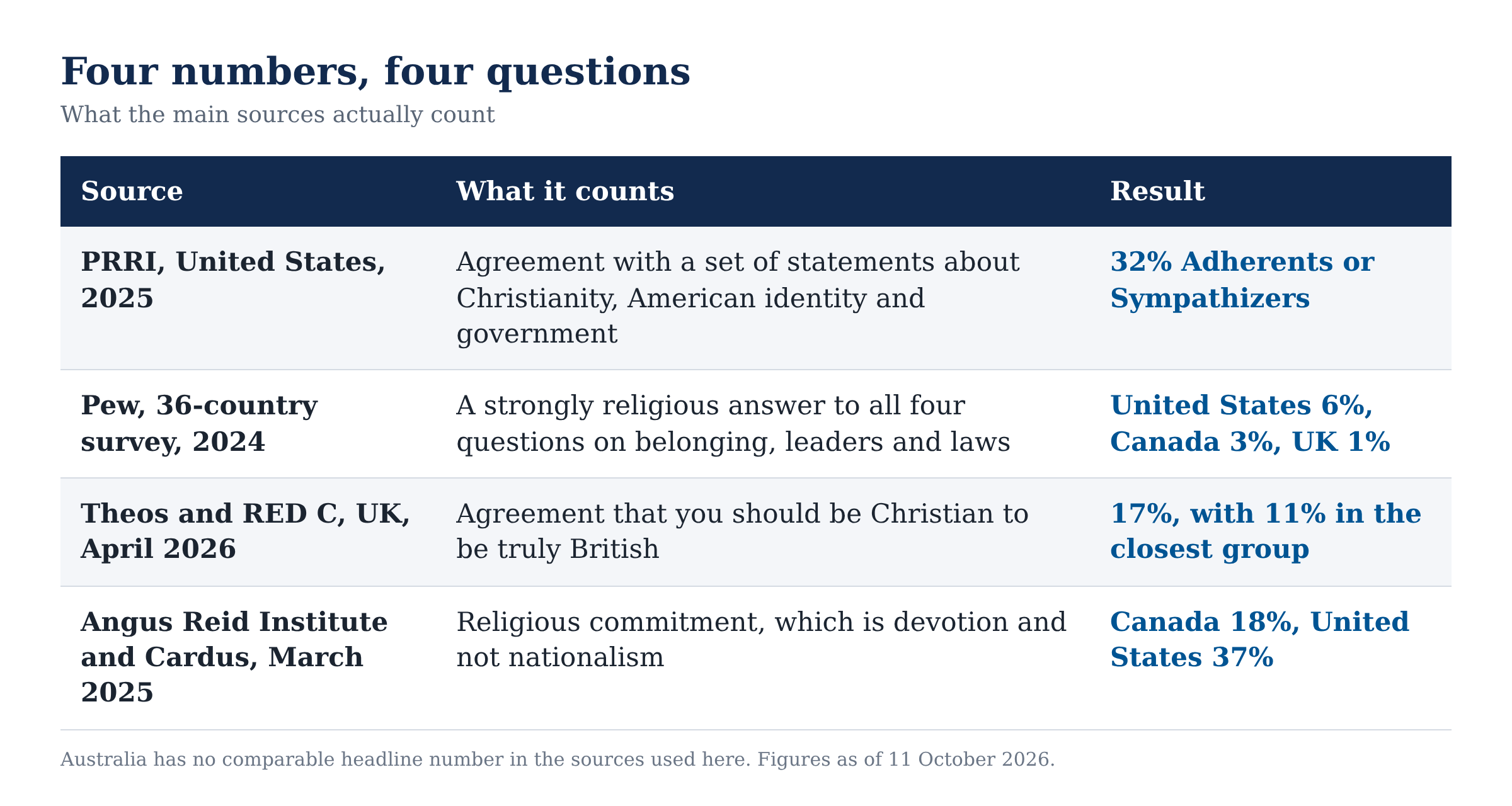
Australia has no comparable headline figure in the sources used here. The evidence there concerns networks and language, not poll shares.
None of these numbers is wrong. They answer different questions. A strict test like Pew’s counts only people who give the strongest answer every time. A looser one like PRRI’s counts people who agree with most of the statements. Each carries a trap. Theos warns that if you define a Christian nationalist by agreement with mild statements, such as allowing religious symbols in public places, you will find a large constituency by definition. Pew admits the opposite problem: more Americans may support individual policies linked to Christian nationalism than the 6 percent its strict test classifies.
Pew adds a finding that cuts both ways. By global standards, the United States has low religious nationalism. Among rich countries, though, it stands out, especially on whether the Bible should shape the law.
Five lines for an index card
Ask the belonging question. Must you be a Christian to truly belong to this nation? That test separates nationalism from ordinary faith in politics.
Count three things, not one: believers, volume, and access to power. They move separately.
Compare shapes, not percentages. Each survey draws its own line.
Check the pews. Where nationalism outruns churchgoing, culture does the work that creed does elsewhere.
Check the machinery. A party, a protest, a lobby, a badge: the same story runs on a different engine in each country.
Higgins did not stop the God clause. He studied the American cases, named what he feared, and wrote a limit into the same constitution before anyone needed it.
The preamble and Section 116 still sit side by side. One invites God into the document. The other bars the Commonwealth from establishing a religion or imposing a religious observance. Ideas cross oceans. Institutions decide what they become.
Higgins said the clause came from America. So did the wall.
Sources
A note on the links: I removed them because they don’t always carry over from the Word doc to Substack, though they usually do on WordPress. I just list the links as a quick start for your own research and reference.
Figures as of 11 October 2026.
United States
PRRI, Breaking Research: 50-State Survey Finds Majority of Republicans Qualify as Christian Nationalism Supporters, 17 February 2026.
Gina Christian, OSV News, More Americans are aware of Christian nationalism, but a negative view of it prevails, 14 May 2026, reporting on the Pew Research Center’s April 2026 survey.
Church Times, Few US adults care for Christian nationalism, 29 May 2026.
Pew Research Center, Comparing Levels of Religious Nationalism Around the World, 28 January 2025.
Britain
Nick Spencer and Yinxuan Huang, Theos, Beyond “Christian nationalism”: Measuring attitudes to Christianity and Britishness today (full report), 11 October 2026.
Nick Spencer, Theos, How big is Christian Nationalism in the UK?, 15 May 2026.
CBS News, London march organized by far-right activist Tommy Robinson, September 2025.
National Catholic Register, Cardinal Vincent Nichols Condemns Words and Symbols Co-Opting Christianity.
Canada
Cardus, Religion in the Public Square, reporting the March 2025 Angus Reid Institute and Cardus survey.
Jonathan Malloy, Carleton University, Canada’s marginal Christian right.
Canadian Journal of Sociology, Why doesn’t Canada have an American-style Christian Right?
Religion Unplugged, How Canada Truckers’ Protest Parallels American-Style Christian Nationalism, 18 February 2022, citing Christine Mitchell in The Conversation.
Perspectives Journal, Christian Nationalism and the Remaking of Canada’s Political Right.
Australia
David Smith, United States Studies Center, A Christian nation no longer, 6 August 2021.
The Other Cheek, A look at Aussie Christian nationalists, on Elenie Poulos.
Northeast Times, Australian church denies paying far-right activists to disrupt election, 21 August 2026.
Canberra Times, Calls for probe into Christian sect’s election role, August 2026.
True North, News update for 29 April 2025, summarizing The Sydney Morning Herald and The Age.
The 1898 Convention
Luke Beck, The Constitutional Prohibition on Imposing Religious Observances, Melbourne University Law Review41 (2017) 493.
Gonzalo Villalta Puig, Parliamentary Prayers and Section 116 of the Australian Constitution, Parliament of Australia.
The Bible Echo, 26 July 1897, Melbourne.