

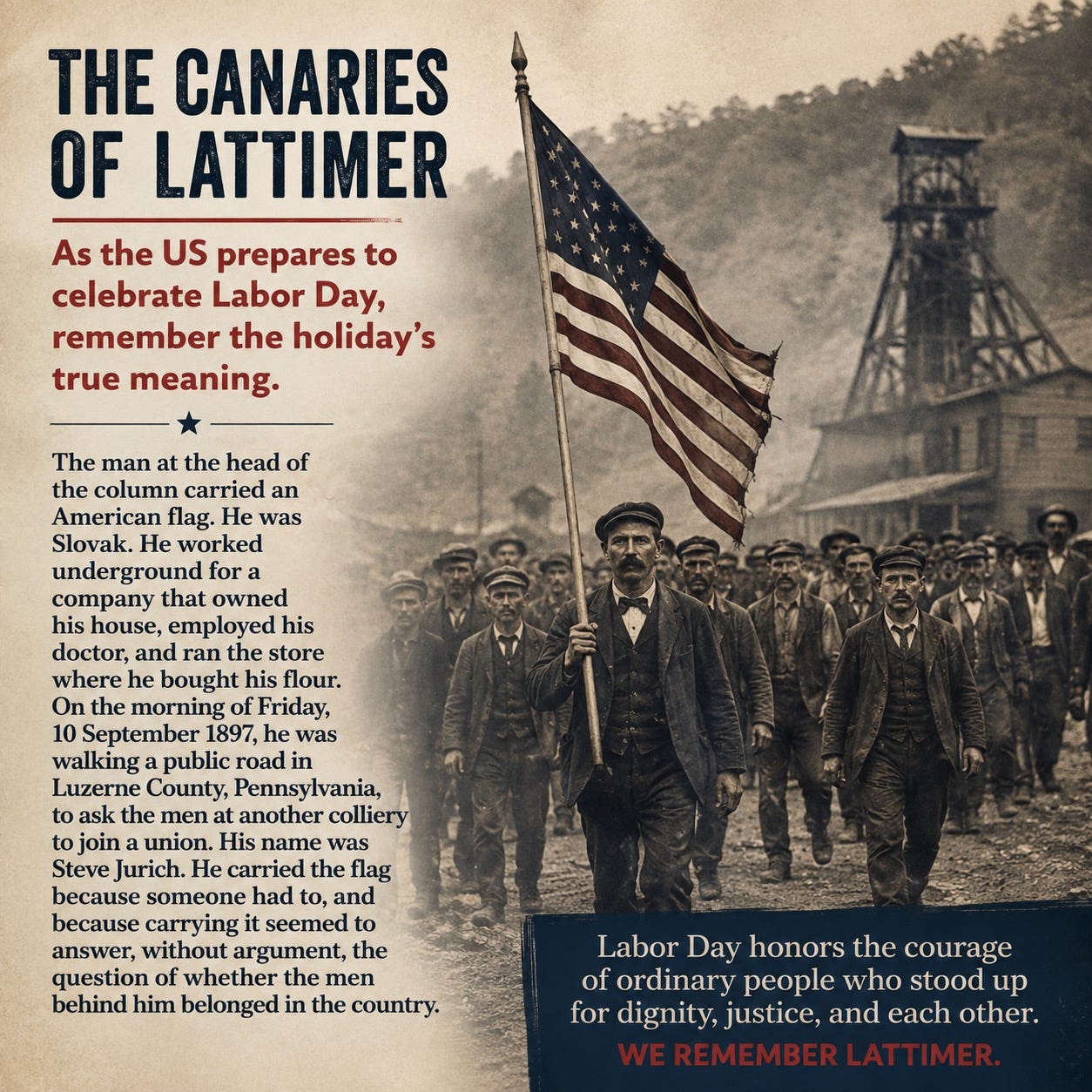
The man at the head of the column carried an American flag. He was Slovak. He worked underground for a company that owned his house, employed his doctor, and ran the store where he bought his flour. On the morning of Friday, 10 September 1897, he was walking a public road in Luzerne County, Pennsylvania, to ask the men at another colliery to join a union. His name was Steve Jurich. He carried the flag because someone had to, and because carrying it seemed to answer, without argument, the question of whether the men behind him belonged in the country.
Roughly four hundred of them had set out from the patch at Harwood. Polish, Slovak, Lithuanian, German. Most of them Catholic. Many of them three or four years off a boat. Not one of them armed.
Sheriff James Martin and his deputies stopped the march on the road south of Lattimer. The shooting lasted about ninety seconds.
Nineteen men died. The indictments counted thirty-eight wounded, and some of the injured died later that week. The testimony at trial was cumulative and undisputed on one point: the strikers were peaceable and unarmed. A number of them had been shot in the back.
Martin and sixty-eight deputies stood before the county magistrates on 20 September 1897. Their trial opened on 1 February 1898 at the courthouse in Wilkes-Barre, before Judge Stanley Woodward. The defense described the dead as invaders from the steppes of Hungary. On 9 March the jury acquitted every defendant.
Ten of the dead had been subjects of Austria-Hungary, and their government did what the men themselves could not. Its minister in Washington pressed the State Department for an indemnity, note after note, into the following year. The Assistant Attorney-General of the United States, Henry M. Hoyt, attended the trial and reported that the verdict was just and righteous. Washington declined to pay.
Then the country moved on. Nineteen men had been killed on a public road, and no monument stood at the place for seventy-five years.
The men on that road did not die over three cents.
Three Cents a Day
The Campbell Act took effect on 21 August 1897. It required coal operators to pay the Commonwealth of Pennsylvania three cents a day for every foreign-born, unnaturalized man on the payroll. The operators did not absorb it. They took it out of the wages.
Two things about that law are usually left out. First,t the United Mine Workers of America (UMWA) lobbied for it. The union the marchers were walking to Lattimer to join had helped pass the tax that put them on the road. It wanted to slow the flow of immigrant labor into the mines, and it was willing to price the men it did not yet represent. The men understood this and marched anyway, which tells you something about what they were after.
The second is the arithmetic. Immigrant miners were already paid 10 to 15 percent less than the English speakers for the same work. They bought from the company store, rented from the company, and were treated by the company doctor. Three cents a day was not the injury. Three cents a day was the receipt.
A wage records what a worker is paid. Everything else on that receipt records what somebody decided the worker was worth.
That distinction runs through every serious labor conflict of the industrial age. The demand on the placard is usually money. The demand underneath is recognition, a grievance procedure, a voice in the rules. Money moves up and down with the market. A seat at the table is different in kind, because it means you are in the room when the rules get written.
Employers have always grasped this more clearly than anyone. It is why they fought organization harder than they ever fought a wage claim.
A Cardinal Writes to Rome
Ten years before Lattimer, Rome nearly condemned the Knights of Labor as a forbidden secret society. The Canadian bishops had already obtained exactly that judgment for Quebec, and several American bishops wanted it extended.
On 20 February 1887, James Cardinal Gibbons of Baltimore sent a memorial in French to Cardinal Giovanni Simeoni at Propaganda Fide. He made three arguments. The Knights’ constitution did not bring it under the Church’s rules on secret societies. American workers had real grievances and a right to resist unjust conditions. And a condemnation would drive American Catholics out of the Church by the hundreds of thousands.
Rome did not condemn the Knights.
Four years later, on 15 May 1891, Leo XIII issued Rerum Novarum. It defended private property, rejected class war, and insisted on a living wage and workers’ right to form associations.
Notice the order of events. The Church did not lead. Workers organized, a bishop who had watched them organize told Rome what refusal would cost, and the teaching followed.
The Coal Hauler’s Son
Henri Cardijn hauled coal in Belgium and wrecked his lungs in the process. Some of what he earned went to keep his son in school. He died on 24 May 1903.
The son was twenty years old. According to his biographers Fiévez and Meert, Joseph Cardijn knelt for his father’s last blessing and resolved there to spend his life as a priest for the salvation of the working masses.
Cardinal Désiré-Joseph Mercier ordained him on 22 September 1906. When the diocese sent him to the parish of Laeken in 1912, he found what he had half expected. The boys and girls from streets like his own were going into the factories at thirteen and fourteen. They were being used up quietly, and the Church was speaking to them in a language they could not hear.
He started with small groups of girls in the needle trades. In 1919 he founded La Jeunesse Syndicaliste. In 1924 it became the Jeunesse Ouvrière Chrétienne (JOC).
His method had three verbs.
See. Look hard at the actual conditions of your life. Judge. Weigh them against the Gospel and the dignity owed to any human being. Act. Change together what can be changed.
That is not a theory of labor. It is a way of handing the instruments of judgment to people who have been told their judgment does not count.
In 1925 Cardijn was brought before Pius XI, who had been warned about him. The pope is said to have replied that someone had come to speak to him about the masses.
By 1938 the JOC counted about 500,000 members across Europe. When Cardijn died on 24 July 1967, two years after Paul VI made him a cardinal, the movement claimed roughly two million members in sixty-nine countries.
He is remembered for a sentence: a young worker is worth more than all the gold in the world.
He was not working alone. John A. Ryan published A Living Wage: Its Ethical and Economic Aspects (New York: Macmillan, 1906) and spent thirty years turning moral philosophy into draft legislation. Dorothy Day and Peter Maurin put out the first Catholic Worker on 1 May 1933. Monsignor George G. Higgins built labor schools and stood in the California fields with César Chávez. In the Basque country, José María Arizmendiarrieta took Cardijn’s three verbs into Mondragón and built a cooperative economy out of them.
What Nobody Handed Down
It is worth being exact about what workers actually won, because these things are usually described as though they arrived with the weather.
The forty-hour week came from the Fair Labor Standards Act, signed on 25 June 1938 and phased in over two years. The same law created overtime pay. Equal pay for equal work became federal law on 10 June 1963. Federal enforcement of workplace safety waited until the Occupational Safety and Health Act, signed on 29 December 1970, seventy-three years after Lattimer.
Behind each of those dates sits a record of strikes, funerals, blocklists, injunctions, organizing drives, and sheriffs found not guilty.
The forty-hour week looks permanent now. In that respect it resembles a monument. Almost nobody who uses one can tell you what it cost.
The Spinning Jenny’s Answer
The strongest case against everything I have just written deserves to be made at full strength, and I have argued it myself.
Since the spinning jenny, every wave of machinery has produced a warning that the machines would eat the jobs, and the warnings have been wrong about the aggregate every time. Machines made workers more productive. Productivity raised wages. People displaced from one trade found another, often a better one. Fighting the machine has generally meant protecting the workers already inside the gate at the expense of consumers, younger workers, and the country’s capacity to compete. A port that refuses to automate loses cargo to a port that does, and the loss spreads outward through every job that touched that cargo. The right policy is to let the technology run fast and make the displaced whole with compensation and retraining. Do not hold up progress at the docks.
On overall employment, that argument has history behind it. On the question at hand, it misses the point.
The men at Lattimer were not trying to stop a machine. They were trying to be in the room.
And the argument smuggles in an assumption it never defends: that the compensation and the retraining will happen. They do not simply happen. They happen when organized people demand them, put them in writing, and attach a date.
Canaries Again
On 12 August 2026, Erik Brynjolfsson, Bharat Chandar, and Ruyu Chen released a revised version of their study “Canaries in the Coal Mine?”, built on ADP payroll records running through June 2026.
They found no economy-wide displacement. Employment across their sample rose about 6 percent from November 2022 to June 2026, and the most AI-exposed quintile grew about 4 percent. That absence of a general collapse is itself a finding, and the authors say so plainly.
The number that should hold your attention is narrower. Workers aged twenty-two to twenty-five in occupations highly exposed to artificial intelligence (AI) now stand about 19 percent below where they would be had they kept pace with their less-exposed peers. Experienced workers show no such gap. In November 2025, the same authors put the figure at 16 percent. It has widened every time they have looked.
The mechanism is not mass dismissal. It is reduced hiring. The doors stop opening, which is a much quieter thing than a layoff and leaves no one to interview.
The authors call these patterns, not causal estimates, and that caution is correct.
Alongside it runs something harder to count. Workers now have routes assigned, keystrokes logged, breaks timed, and performance ranked by systems whose rules they cannot read. In some workplaces, the software recommends the discipline and the dismissal. The worker does not know what the system measured, how it weighted id, or whom to ask.
The resemblance to the Campbell Act is not exact. The moral shape is the same. A rule arrives from somewhere out of reach and assigns a value to a person, and the person pays it out of their wages.
Rome has noticed again. Robert Prevost took the name Leo when he was elected in 2025, and he signed his first encyclical, Magnifica Humanitas, on 15 May 2026, the 135th anniversary of Rerum Novarum. The Holy See released it ten days later. It calls artificial intelligence a genuine gift, capable of relieving real suffering, and it denies that the pursuit of profit can justify decisions that systematically sacrifice human work.
Workers had already reached the same conclusion without waiting for an encyclical.
After a three-day strike shut fourteen East and Gulf coast ports in October 2024, members of the International Longshoremen’s Association ratified a six-year contract on 25 February 2025 with nearly 99 percent in favor. It runs through 30 September 2030 and raises wages 62 percent. It did not ban automation. It permits limited semi-automated equipment and ties that equipment to job guarantees, which is a harder and more interesting thing than a ban.
Argue about the terms if you like. The subject underneath them was not wages. It was who decides how the technology gets used, and that question only ever gets asked where workers are organized. Everywhere else it is not a negotiation. It is a notice.
See, Judge, Act
Cardijn’s method still fits on an index card.
See. Find out what the system actually does. What does it measure? Which decisions does it make? Which of those decisions used to belong to a person?
Judge. Ask the moral question and answer it out loud. Does this serve the people doing the work, or only the people who bought the software?
Act. Put it in writing: notice before deployment, a right of appeal, a human being who can explain a decision, retraining with a start date rather than a promise.
And do it together. One worker who questions an algorithm has raised a personnel matter. Four hundred workers who ask the same question have opened a negotiation.
The road from Harwood to Lattimer is still there. It is paved now, and in 1972 the state finally set a granite marker beside it, seventy-five years late.
Steve Jurich carried a flag up that road because he thought it settled the question. It did not. The men behind him didn't want to stop any machine. They wanted to be treated as men while the machines ran, and to be in the room when the rules were made.
The canaries are singing again.
Somebody should be listening.
Sources. Foreign Relations of the United States, 1898 (correspondence of Hoyt, Coxe, Day, and Hengelmüller on the Lattimer indemnity claim); Michael Novak, The Guns of Lattimer; Paul A. Shackel, Remembering Lattimer; Pennsylvania Heritage, “The Lattimer Tragedy of 1897”; James Cardinal Gibbons, memorial to Cardinal Simeoni, 20 February 1887; Leo XIII, Rerum Novarum, 15 May 1891; Leo XIV, Magnifica Humanitas, 15 May 2026; Fiévez and Meert, Cardijn; Erik Brynjolfsson, Bharat Chandar, and Ruyu Chen, “Canaries in the Coal Mine? Six Facts about the Recent Employment Effects of Artificial Intelligence,” Stanford Digital Economy Lab, August 2026.