

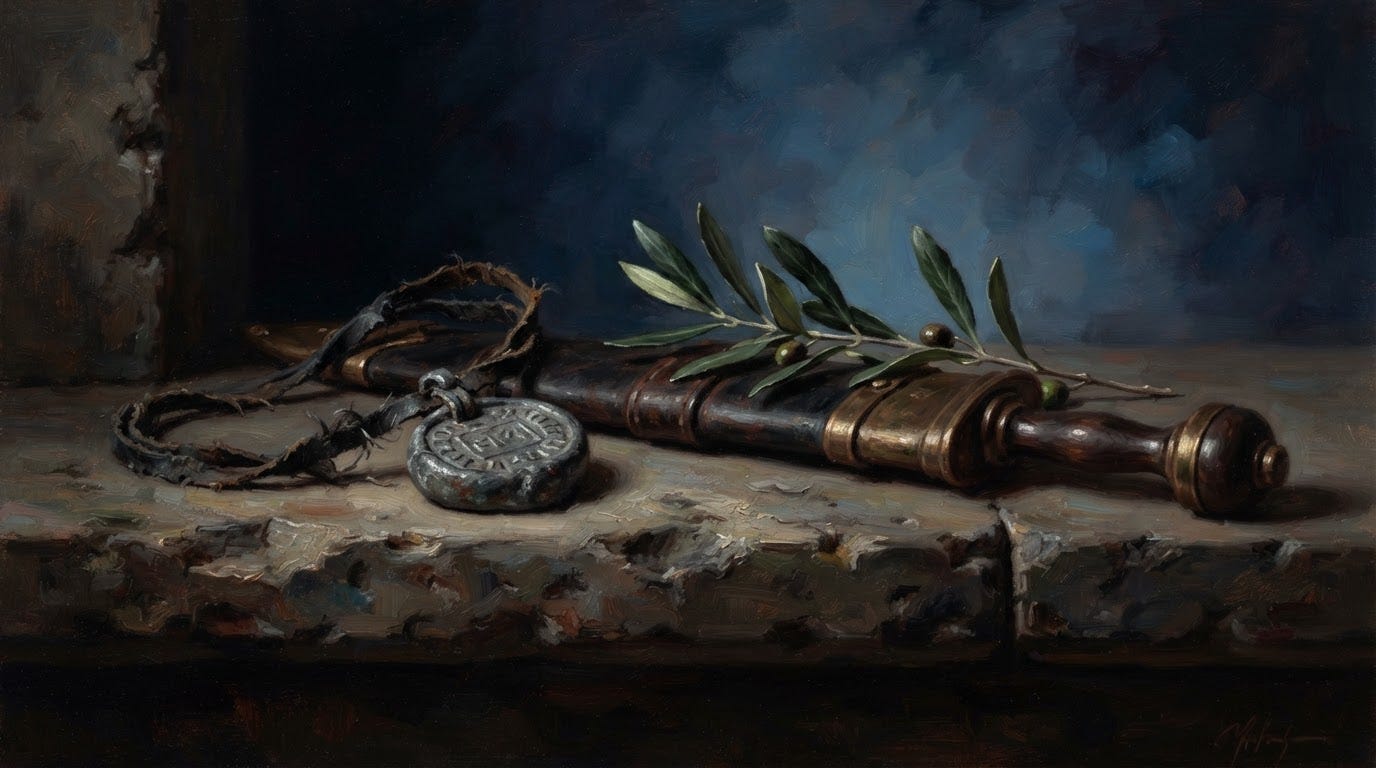
The recruiting officer liked what he saw. The young man standing before him in Theveste, a Roman garrison town in Numidia, in what is now eastern Algeria, was twenty-one, healthy, and tall. The law said he had to serve. His father, Fabius Victor, was the local official who collected the tax that paid to outfit new recruits, and the same law obliged him to present his own son.
The year was 295. The young man’s name was Maximilian.
When the proconsul Dion asked his name, Maximilian answered with a refusal instead. He could not serve, he said, because he was a Christian. Dion ordered him measured anyway. The officer called out the height: five feet ten. Dion ordered him given the soldier’s mark, a lead seal bearing the emperor’s image, to be worn around the neck. Maximilian replied that he already carried the sign of Christ.
Then the proconsul turned to the father and told him to counsel his son.
Fabius Victor declined. His son, he said, knew his own mind and could decide for himself what was right.
Dion tried one more argument. Christians already served in the emperor’s own guard, he pointed out. Maximilian answered that they knew what was right for them. For himself, he could not do evil.
He was sentenced to die by the sword. Before the sentence was carried out, he asked his father to give the executioner the new clothes the family had bought for his soldiering. Fabius Victor went home, the record says, rejoicing and giving thanks to God.
That record survives as the Acts of Maximilian, probably written down before 313. The Church keeps his feast on 12 March. He is the earliest conscientious objector whose name and words have come down to us.
The question Dion put to Fabius Victor is one many parents and grandparents may soon hear in a quieter form.
What would you say if your son, grandson, nephew, or a neighbor’s son asked you about the draft? Would you tell him what Thomas Merton believed about conscience, military service, and the duty to work for peace? And would you know that Merton was standing in a line of Christians that runs straight back to that courtroom in Theveste?
Observe: A Law Waiting for Its Rulebook
The question is no longer hypothetical. Section 535 of the National Defense Authorization Act for Fiscal Year 2026 (Public Law 119-60), signed on 18 December 2025, orders the Selective Service System (SSS) to register eligible young men automatically from federal records. The law takes effect one year after signing, on 18 December 2026.
The agency has not yet said how it will do this. Selective Service sent its implementing rule for White House review on 30 March 2026, withdrew it on 23 July 2026 without public explanation, and has not replaced it. Until a new system is running, the old duty stands: men register themselves within 30 days of turning eighteen, and may register late until twenty-six.
Three facts belong in any family conversation about this:
Registration is not a draft. Restarting conscription would take a separate act of Congress and the President.
Registration remains male-only. Proposals to include women have failed in several defense bills.
No one can be classified as a conscientious objector in advance. A claim is made only after an induction notice arrives, and the Center on Conscience & War notes that the window to file is about ten days. That is why the thinking has to happen now.
The monk who faced the draft himself
Thomas Merton did not write about conscription from a safe distance. Before he entered the monastery, he faced the World War II draft. In March 1941 he wrote out his reasons for asking exemption from combatant duty and sought noncombatant service instead. He later explained in The Seven Storey Mountain (Harcourt, Brace, 1948) that he was trying to do “what I thought Christ would do.” The Army rejected him that year for having too few teeth. Standards loosened as war approached, but by then he had made a different choice. He entered the Abbey of Gethsemani on 10 December 1941.
His thinking deepened over the next two decades. In October 1961 The Catholic Worker published “The Root of War Is Fear,” an expanded chapter of his New Seeds of Contemplation. Its most quoted passage reads:
“The duty of the Christian in this crisis is to strive with all power and intelligence, with his faith, hope in Christ, and love for God and man, to do the one task which God has imposed upon us in the world today. That task is to work for the total abolition of war.“
Merton did more than write. He sponsored the Catholic Peace Fellowship (CPF), which Jim Forest and Tom Cornell founded in 1964 to counsel young Catholics facing the draft. He wrote letters to local draft boards on behalf of young men he had counseled, among them Joseph Morse in April 1965 and Christopher Burke in September 1966. On 19 February 1968 he wrote to Louisville Local Board 47 as spiritual advisor to Joseph Mulloy, whose objection was to one particular war, the war in Vietnam.
He also drew lines. When Roger LaPorte set himself on fire in front of the United Nations on 9 November 1965, Merton asked to withdraw as a CPF sponsor. He stayed after Forest answered him. He respected Cornell’s decision to burn his draft card, but he did not favor card burning as a mass tactic.
That pattern matters. Merton supported the legal right to conscientious-objector status, and in some cases nonviolent resistance to the draft. He did not bless every form of refusal or every protest. His concern was always the moral responsibility underneath the action. For Merton, saying yes or no to military service was never the whole question. The whole question was whether a person had listened to conscience, accepted responsibility for the choice, and understood that working for peace is part of living the Christian faith.
Discern: The Question Before the Question
Before anyone asks whether to register, serve, or object, a deeper question waits: what does it mean to follow Christ in a world that prepares for war?
Christians have asked it since the first generation. Merton did not invent a new argument about peace. He drew on a tradition that runs from the Gospels through the early Church, and that tradition never spoke with a single voice.
Blessed are the makers
The starting point is not a policy. It is the teaching and example of Jesus. These passages carry the most weight:
Matthew 5:9. “Blessed are the peacemakers.“ Peace is something Christians actively make.
Matthew 5:38–48 and Luke 6:27–36. Love your enemies, pray for those who persecute you, do good to those who hate you.
Matthew 26:52. Jesus tells Peter to put his sword back in its place.
John 18:36. Jesus tells Pilate that his kingdom is not of this world.
Romans 12:17–21. Do not repay evil for evil; overcome evil with good.
James 4:1–2. James asks where wars and conflicts come from, and answers: from the cravings at war within us.
Three of these deserve to be read slowly.
Matthew 5:9. Jesus does not bless people who wish for peace. He blesses those who make it. Peace is not passive. It asks for courage, sacrifice, forgiveness, and the will to change the conditions that breed violence.
Matthew 5:44. Love your enemies. This is the hardest teaching in the whole discussion. How does a Christian love an enemy while preparing to kill that enemy? The question deserves to be put to a room of adults and left there for a while, without an easy answer.
Matthew 26:52. When Peter draws a sword to defend Jesus, Jesus tells him to put it away. Christians have argued for centuries over what this covers: personal violence, military service, the state, or every use of force. The readings differ. The challenge of the words does not.
An army of prayer
For the first three centuries, many Christian writers had serious reservations about military service. Their concerns were killing, the pagan sacrifices woven into army life, the cult of the emperor, and an oath of loyalty that competed with baptism. Three witnesses stand out.
Tertullian of Carthage (about 155–220) was the sharpest early voice. In On the Crown (De Corona), chapter 11, he asks whether a follower of Christ may take up the sword, whether one commanded to love enemies may kill them, and whether a Christian may swear an oath that rivals the oath of baptism. He draws a distinction worth keeping: a soldier who becomes a Christian stands in a different place from a Christian who chooses to enlist. Elsewhere, in On Idolatry, chapter 19, he reads Matthew 26:52 bluntly: in disarming Peter, he writes, the Lord “unbelted every soldier.”
For Merton’s readers, Tertullian sharpens the issue. The question is not only what the government requires. It is whether the requirement fits the call to follow Christ.
Origen of Alexandria (about 185–254) answered a pagan critic, Celsus, who charged that Christians shirked their duty to defend the empire. In Against Celsus, Book VIII, chapters 73–74, Origen replies that Christians do serve, as “an army of piety,” through prayer, moral formation, and the struggle against the evils that produce war. They protect society differently from soldiers who fight and kill.
This is the clearest bridge to Merton, and Merton walked across it himself. In “The Christian in World Crisis,” in Seeds of Destruction (Farrar, Straus & Giroux, 1964), he turned to this very exchange between Origen and Celsus. Origen’s question is still the right one: does defending a country always mean taking up arms, or are there other ways to serve humanity and build peace?
The Apostolic Tradition, a church order traditionally linked to Hippolytus of Rome, is the most direct of the three. In its rules for those seeking baptism, it says a soldier must be told not to kill, even under orders, and that a catechumen or believer who wants to enlist should be turned away. Scholars still debate its author, date, and transmission, but it remains strong evidence of early Christian moral concern. Its implication is plain: the state’s authority did not automatically override a Christian’s duty not to kill.
Three years outside the rail
It would be wrong to suggest that every early Christian held the same view. As the Church grew and became bound up with imperial government, the conversation changed. Two Fathers show how.
Basil the Great (about 330–379), in Letter 188, canon 13, notes that earlier Fathers did not count killing in war as murder. Then he adds something striking. Soldiers whose hands have shed blood, he suggests, might do well to abstain from Communion for three years. Even while drawing a line between murder and killing in war, Basil refused to treat the taking of a human life as spiritually weightless. His canon asks a question that still has no expiration date: even when something is legally or morally permitted, what does it do to the soul?
Augustine of Hippo (354–430) gave the Church the foundations of what became just-war reasoning. He accepted that rulers must protect their people and keep civil order, and he did not consider all military action sinful. In Against Faustus, Book XXII, sections 74–75, he names “the real evils in war“: the love of violence, cruelty, and the lust for power. He weighs the reason for a war and the authority that wages it, and he considers the soldier who serves under a ruler whose decisions may not be just.
Augustine did not write a blank check. His questions still form the core of the tradition:
Is there a genuinely just reason to use force?
Is the aim to protect peace rather than take revenge?
Is the authority legitimate?
Is the response proportionate to the threat?
Is there a sincere desire to restore peace?
Augustine is the necessary counterweight to Tertullian and Origen. The early Church did not settle on one universally accepted position on military service.
Caesar and conscience
For a family talking about the draft, this may be the most important passage of the tradition, because two biblical teachings have to be held together.
In Romans 13:1–7, Paul affirms the role of government in keeping order and protecting society. The passage is often cited to argue that Christians must obey legitimate civil authority.
In Acts 5:29, ordered to stop preaching in the name of Jesus, Peter and the apostles answer: “We must obey God rather than men.“ Human authority is real, and it is not absolute.
And Paul himself, one chapter earlier, in Romans 12:21: “Do not be overcome by evil, but overcome evil with good.“
Christians cannot escape the tension between these texts. A Christian owes real duties to family, community, and country. Those duties do not cancel the duty to follow conscience and remain faithful to Christ. The honest question is this: when the demands of government and the demands of conscience seem to conflict, how does a Christian discern what God is asking? That is not a license to ignore every law. It is a call to serious moral discernment.
The centurion’s faith
The strongest case on the other side deserves to be made at full strength, because its defenders make it from Scripture too.
Luke 3:14. Soldiers ask John the Baptist what they should do. He tells them not to extort money, not to make false accusations, and to be content with their wages. He does not tell them to leave the army.
Matthew 8:5–13. Jesus meets a Roman centurion and praises his faith above any he has found in Israel.
Acts 10. Cornelius, a centurion, receives the Gospel and is baptized. Nothing in the account says he must resign.
To these, many Christians add a moral argument: protecting the weak from aggression can itself be an act of love, and someone has to stand between the innocent and those who would harm them. The Catechism of the Catholic Church calls those who serve honorably in the armed forces “servants of the security and freedom of nations“ (2310), even as it asks governments to provide for those who refuse to bear arms for reasons of conscience (2311). A young Catholic may discern, in good conscience, that honorable military service is right for him.
The New Testament gives no simple rule ordering every Christian out of the military. That is exactly why the subject needs serious reflection instead of slogans.
The real question is how service, force, and obedience can be reconciled with the life and teaching of Jesus.
The Church’s own answer is still developing. In Magnifica Humanitas (15 May 2026), 192, Pope Leo XIV judges just-war theory “now outdated“ as a practical guide, while keeping the right to self-defense “in the strictest sense.” Some moral theologians argue that this goes beyond the Catechism, whose text on legitimate defense (2307–2317) is unchanged. Both readings should be on the table in any honest conversation.
What Merton inherited
Read against this history, Merton looks less like an innovator and more like an heir. Each early voice finds an echo in him:
Tertullian asked whether a Christian can follow Christ and make a profession of the sword. Merton insisted that conscience must be consistent with Christian identity.
Origen said Christians serve society through prayer and moral transformation. Merton taught that peace requires changing the human conditions that produce war.
Basil held that killing in war carries spiritual consequences. Merton refused to treat human life or violence casually.
Augustine said the reasons, authority, and purposes of war matter. Merton demanded moral discernment, because not every war or every order is justified.
The deepest link is fear. In “The Root of War Is Fear,” Merton asks readers to look beneath political quarrels, arms races, and national rivalries. War is not only a matter of weapons and armies. It grows from the human heart: fear, insecurity, hatred, pride, and the failure to see another person’s humanity. There the teaching of Jesus, the answer of Origen, and the warning of Merton meet. Peace in the world begins with an honest look at whatever keeps us from recognizing one another as brothers and sisters.
Act: Before the Letter Comes
The US Catholic bishops saw this moment coming long ago. In their Statement on Registration and Conscription for Military Service (14 February 1980), they asked schools and religious educators to provide “systematic formation of conscience“ on war and peace. Pope Leo XIV makes the same appeal in Magnifica Humanitas 238, calling adults to be “artisans of education“ for the young. Formation is the work of parents and grandparents, and it cannot start after an induction notice arrives.
Six questions for the kitchen table
If your grandson asked whether he should serve in the military, would you talk with him about what Jesus taught about loving our enemies?
Have we taught our children that following conscience can sometimes mean disagreeing with the government?
Do we know what the earliest Christians understood about military service and following Christ?
Is serving one’s country always the same thing as serving humanity?
If every human being is created in the image of God, how should that belief shape the way we think about war?
Are we teaching the next generation how to build peace, or mainly how to prepare for conflict?
Five things a family can do on Monday
Get the facts straight first. Registration is still required, it is not a draft, and it currently applies only to men. A young man who misses it can lose access to some federal jobs and benefits.
Talk before the paperwork. Read Matthew 5 together, then the story of Maximilian, then Merton’s “The Root of War Is Fear.” Ask the six questions above and listen longer than you speak.
Put convictions on paper now. The Center on Conscience & War advises writing a statement of belief, sending it to Selective Service by certified mail, and keeping copies. It also warns that automatic registration may change how objectors identify themselves, so check its current guidance.
Know where to turn. The Catholic Peace Fellowship in South Bend, which Merton once sponsored, and the Center on Conscience & War both counsel young people on conscience and the draft.
Honor every honest outcome. A young person who discerns that honorable service is right, and one who discerns objection, have both done the work Merton asked for. What he could not accept was the choice made without thinking.
Three Things, Not One
The whole conversation rests on a distinction Merton kept clear:
Conscientious objection is a matter of personal moral responsibility.
Christian peacemaking is the responsibility of the entire Christian community.
The abolition of war is a vision of what humanity might become if we took the teaching of Jesus seriously.
The three are related, but they are not the same. Together they make a larger message than a debate about the draft. They ask what kind of human beings we are raising, what kind of world we are building, and whether we live the Gospel we profess. Peace is not simply the absence of war. It is a responsibility we carry for one another.
In the courtroom at Theveste, the proconsul turned to Fabius Victor and told him to counsel his son. The father had nothing left to say. He had already said it, at home, over twenty-one years.
That is the work in front of us.
Not a speech when the letter comes, but a formation long before it, so that when a young man is asked what he will do, he knows his own mind and has a conscience worth trusting. As Merton reminds us, working for the abolition of war is not somebody else’s task. It belongs to every Christian.
The counsel has to come first.
And that is Wisdom Speaking.
Sources
Acts of Maximilian (about 295; written down before 313). Background: Peter Brock, “Why Did St Maximilian Refuse to Serve in the Roman Army?,” Journal of Ecclesiastical History 45:2 (April 1994), 195–209.
Selective Service System, Conscientious Objectors; Reginfo.gov, RIN 3240-AA09, Automatic Registration.
Center on Conscience & War, Document Your Claim as a Conscientious Objector.
Catholic Peace Fellowship, South Bend, Indiana.
Thomas Merton, The Seven Storey Mountain (Harcourt, Brace, 1948); New Seeds of Contemplation (New Directions, 1961); “The Root of War Is Fear,” The Catholic Worker, October 1961; Seeds of Destruction (Farrar, Straus & Giroux, 1964).
William H. Shannon, on “The Root of War” in The Catholic Worker, The Merton Seasonal 10:3.
Thomas Merton Center, Letters to Local Draft Boards and Mulloy correspondence.
Jim Forest, “Thomas Merton’s Struggle with Peacemaking.”
Tertullian, De Corona 11 and De Idololatria 19; Origen, Contra Celsum VIII.73–74; Apostolic Tradition 16; Basil the Great, Letter 188, canon 13; Augustine, Contra Faustum XXII.74–75.
Daniel H. Weiss, “Christians as Levites: Rethinking Early Christian Attitudes toward War and Bloodshed via Origen, Tertullian, and Augustine,” Harvard Theological Review 112:4 (2019), 491–516.
Catechism of the Catholic Church 2307–2317.
USCCB, Statement on Registration and Conscription for Military Service (14 February 1980).
Pope Leo XIV, Magnifica Humanitas (15 May 2026), 192, 238.
Richard Pütz, “Thomas Merton, Origen, and the Christian Case for Peace,” Cardijn Reflections.