

Introduction
We are reflexive beings. Susie Scott defines reflexivity as “the ability to think about ourselves.” Terry and Hayfield, two researchers who make use of reflexive thematic analysis, state that reflexivity includes our values, backgrounds, decisions and interests. I would dare to add to their list our beliefs and our memories.
But what has this to do with the Gospel for the Second Sunday of Lent? First, the Gospel Enquiry is intended as a means for deepening our relationship with Jesus, which means we take time to reflect on our relationship with him by means of the Gospel. And the method, captured in the three words “See, Judge, Act,” will be effective to the extent that we commit to reflecting on the presence of God in our lives.
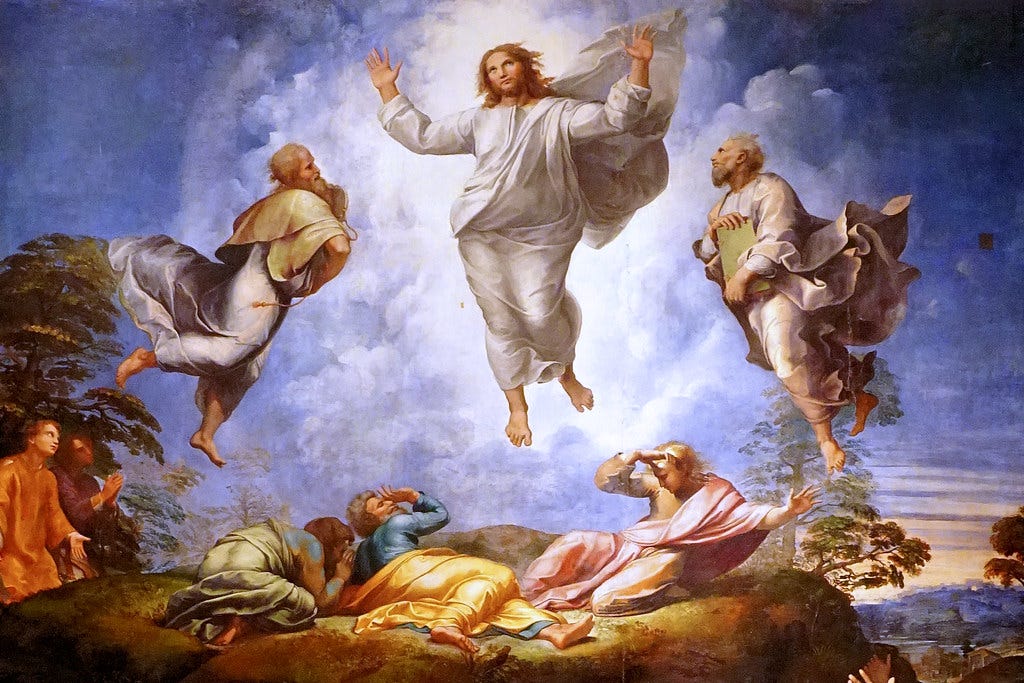
Second, Christians have reflected on the mystery of Christ from the very beginning of the mission of the Church. The Gospel account of the transfiguration of Jesus is a proclamation of his divinity and the silence of Peter, James and John in the aftermath of their experience of the divine speaks not only of the reflexivity of the human person, but also of the experience of mystery.
God created us to be reflexive. St Paul reminded us of this when he wrote to the Christians in Colossae: “You must not be moved away from the hope brought to you by the Good News that you heard” (Colossians 1:23). May this Gospel Enquiry help you to hear the Good News and reflect on the mystery of your relationship with God.
The Gospel
Jesus took with him Peter and James and his brother John and led them up a high mountain where they could be alone. There in their presence he was transfigured: his face shone like the sun and his clothes became as white as the light. Suddenly Moses and Elijah appeared to them; they were talking with him. Then Peter spoke to Jesus. ‘Lord,’ he said ‘it is wonderful for us to be here; if you wish, I will make three tents here, one for you, one for Moses and one for Elijah.’ He was still speaking when suddenly a bright cloud covered them with shadow, and from the cloud there came a voice which said, ‘This is my Son, the Beloved; he enjoys my favour. Listen to him.’ When they heard this the disciples fell on their faces, overcome with fear. But Jesus came up and touched them. ‘Stand up,’ he said ‘do not be afraid.’ And when they raised their eyes they saw no one but only Jesus.
As they came down from the mountain Jesus gave them this order, ‘Tell no one about the vision until the Son of Man has risen from the dead.’ (Matthew 17:1-9)
The Enquiry
See
What would you include in the storyline of this Gospel event? Which elements can be used to place the story in its wider religious context or tradition? Which element(s) make this event unique?
Does Jesus being transfigured change anything in the Gospel narrative?
Why does the Gospel writer include this event in his account?
Judge
What do you think about the transfiguration of Jesus: Is it just a story? a theological reflection? a metaphor? Or is it about a religious experience (an experience of the divine in a place we can find on a map)?
Ideally, how should people respond to the Tabor experience?
Where would you place yourself in this Gospel? Are you one of the many who have not followed Jesus up the mountain? Have you had your own Tabor experience? With whom have you shared your experience?
Act
So, having reflected on the story of the transfiguration of Jesus and the purpose of the account in Matthew’s Gospel, what have you concluded about what needs to change in the world and in yourself?
What small action can you carry out that will contribute to the change God is calling you to make?
Who can you involve in your action, when, where and how often?
Image Source: Slices of Light (Creator), Room VIII, Pinacoteca, Vatican Museum; July 2019, Flickr, CC BY-NC-ND 2.0
Of Interest: Scott, S. (2015). Negotiating Identity: Symbolic Interactionist Approaches to Social Identity. Cambridge: Polity Press.
Terry, G. and Hayfield, N. (2021). Essentials of Thematic Analysis. Washington: American Psychological Association.