

Introduction
The Gospel featured in this enquiry is used in the celebration of the Fourth Sunday in Lent, Year A. The Second Scrutiny ritual draws on the miracle of the healing of the man born blind as the prompt to pray that the Elect be freed from slavery to sin, that the desire for good to be stirred within them and that they become “staunch and fearless witnesses to the faith.” This will happen through Christ our Lord.
It is a timely lesson to be learnt, that all good comes from God and in God’s good time. It might seem trite to say that we are creatures of habit, but it is true nonetheless. Just as Google might suggest common ways of stating the obvious, we tend to develop patterns of behaviour that keep us safe, or promise short-term rewards. In this case, the man had grown up being blind and had learned ways of dealing with his blindness. He did not ask to be healed of his blindness. God’s gifts are gratuitous.
Being creatures of habit, we tend to resist anything that threatens to take us out of our comfort zone … unless we are courageous enough to entertain the thought that such change might prove to be beneficial. Miracles do happen. We can change. Conversion is possible … in God’s good time.
The Gospel
As Jesus went along, he saw a man who had been blind from birth. His disciples asked him, ‘Rabbi, who sinned, this man or his parents, for him to have been born blind?’
‘Neither he nor his parents sinned,’ Jesus answered ‘he was born blind so that the works of God might be displayed in him. As long as the day lasts I must carry out the work of the one who sent me; the night will soon be here when no one can work. As long as I am in the world I am the light of the world.’
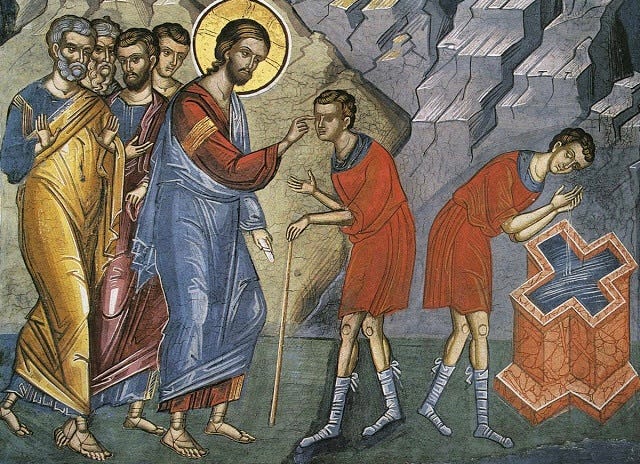
Having said this, he spat on the ground, made a paste with the spittle, put this over the eyes of the blind man, and said to him, ‘Go and wash in the Pool of Siloam’ (a name that means ‘sent’). So the blind man went off and washed himself, and came away with his sight restored.
His neighbours and people who earlier had seen him begging said, ‘Isn’t this the man who used to sit and beg?’ Some said, ‘Yes, it is the same one.’ Others said, ‘No, he only looks like him.’ The man himself said, ‘I am the man.’ So they said to him, ‘Then how do your eyes come to be open?’ ‘The man called Jesus’ he answered ‘made a paste, daubed my eyes with it and said to me, “Go and wash at Siloam”; so I went, and when I washed I could see.’ They asked, ‘Where is he?’ ‘I don’t know’ he answered.
They brought the man who had been blind to the Pharisees. It had been a sabbath day when Jesus made the paste and opened the man’s eyes, so when the Pharisees asked him how he had come to see, he said, ‘He put a paste on my eyes, and I washed, and I can see.’ Then some of the Pharisees said, ‘This man cannot be from God: he does not keep the sabbath.’ Others said, ‘How could a sinner produce signs like this?’ And there was disagreement among them. So they spoke to the blind man again, ‘What have you to say about him yourself, now that he has opened your eyes?’ ‘He is a prophet’ replied the man. However, the Jews would not believe that the man had been blind and had gained his sight, without first sending for his parents and asking them, ‘Is this man really your son who you say was born blind? If so, how is it that he is now able to see?’ His parents answered, ‘We know he is our son and we know he was born blind, but we do not know how it is that he can see now, or who opened his eyes. He is old enough: let him speak for himself.’ His parents spoke like this out of fear of the Jews, who had already agreed to expel from the synagogue anyone who should acknowledge Jesus as the Christ. This was why his parents said, ‘He is old enough; ask him.’
So the Jews again sent for the man and said to him, ‘Give glory to God! For our part, we know that this man is a sinner.’ The man answered, ‘I don’t know if he is a sinner; I only know that I was blind and now I can see.’ They said to him, ‘What did he do to you? How did he open your eyes?’ He replied, ‘I have told you once and you wouldn’t listen. Why do you want to hear it all again? Do you want to become his disciples too?’ At this they hurled abuse at him: ‘You can be his disciple,’ they said ‘we are disciples of Moses: we know that God spoke to Moses, but as for this man, we do not know where he comes from.’ The man replied, ‘Now here is an astonishing thing! He has opened my eyes, and you don’t know where he comes from! We know that God doesn’t listen to sinners, but God does listen to men who are devout and do his will. Ever since the world began it is unheard of for anyone to open the eyes of a man who was born blind; if this man were not from God, he couldn’t do a thing.’ ‘Are you trying to teach us,’ they replied ‘and you a sinner through and through, since you were born!’ And they drove him away.
Jesus heard they had driven him away, and when he found him he said to him, ‘Do you believe in the Son of Man?’ ‘Sir,’ the man replied ‘tell me who he is so that I may believe in him.’ Jesus said, ‘You are looking at him; he is speaking to you.’ The man said, ‘Lord, I believe’, and worshipped him.
Jesus said: ‘It is for judgement that I have come into this world, so that those without sight may see and those with sight turn blind.’
Hearing this, some Pharisees who were present said to him, ‘We are not blind, surely?’ Jesus replied: ‘Blind? If you were, you would not be guilty, but since you say, “We see,” your guilt remains.’ (John 9:1-41)
The Enquiry
See
Cardijn refers to the Truth of Faith in conflict with the Truth of Experience. Use these categories to analyse this Gospel event. If you are unsure about the meaning of these terms, then read the opening section of Fr Joseph Cardijn’s lecture on the Three Truths.
Examine the impact of Jesus’ act of healing the man’s blindness. Consider in turn, the man, his parents, the Pharisees, and you.
Why do the Pharisees refuse to see the miracle as a sign of God’s presence and power in their midst?
Judge
What do you think about the understanding of faith represented by the Pharisees? Does Jesus’ act of healing the blind man on the Sabbath represent a new spirituality?
Where would you place yourself in this Gospel? Are you one of the many who witnessed Jesus healing the blind man? Are you one of the Pharisees and you refuse to recognise the work of God in the healing of the man’s blindness? Have you been healed of blindness?
What is the Christian principle that is illustrated by this story? How would your life change if you lived by this principle?
Act
So, having reflected on this story, what are you being called to change in the world and in yourself?
What small action can you carry out that will contribute to the change God is calling you to make?
Who can you involve in your action, when, where and how often?
Image Source: juan50300 (Creator), La curation del cie go de nacimiento 2017, Flickr, CC BY-NC-SA 2.0