

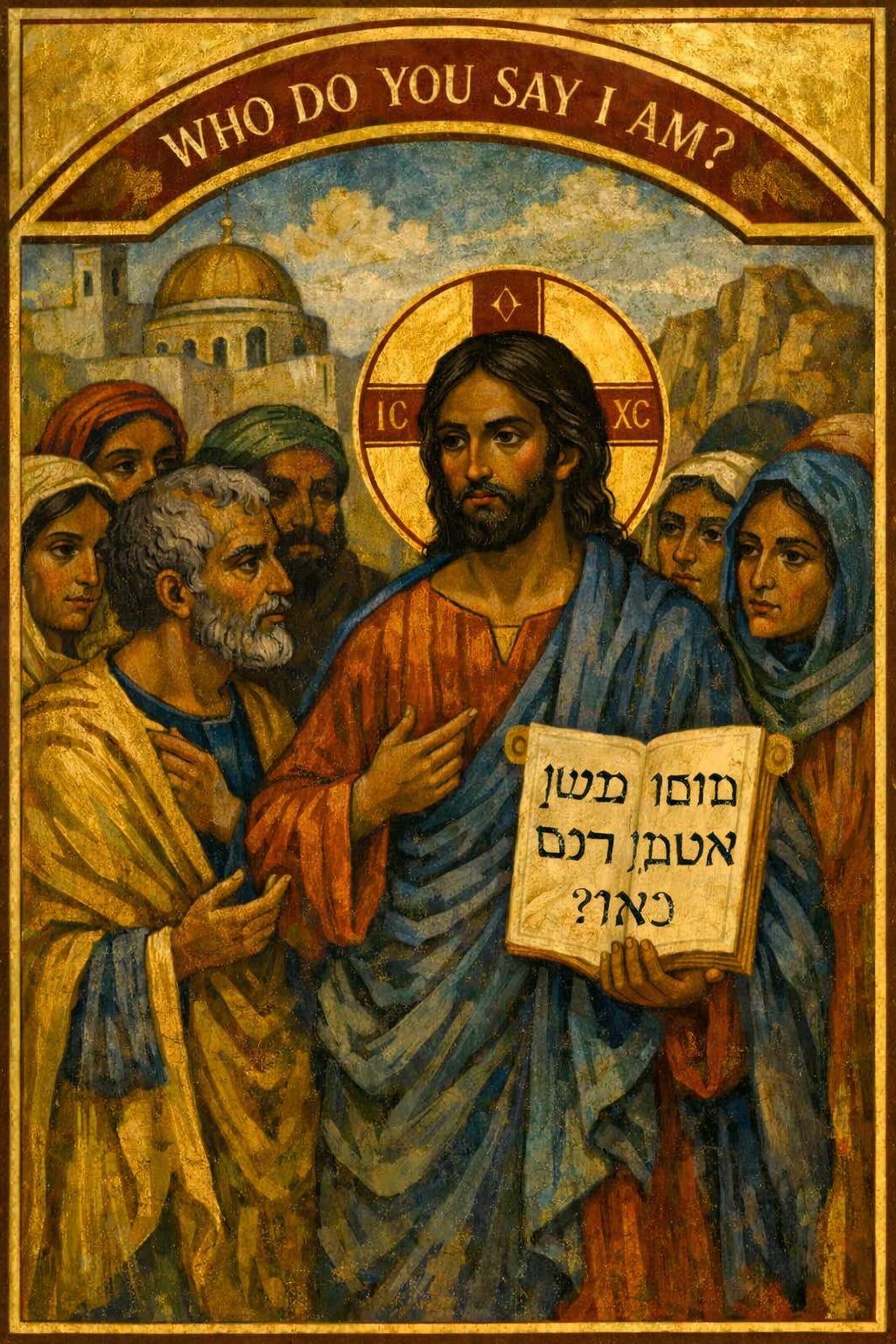
The middle chapters of Matthew’s Gospel have shown Jesus gradually seeking to build an understanding among his followers about his true identity and mission. This text, which is something of a mid-point in the Gospel narrative is set in the Northern Region of Caesarea Philippi, quite remote from the region of Galilee, most familiar to Jesus, and far flung from the city of Jerusalem, the centre of the Jewish religion.
The answer to Jesus’ question ‘Who do people say the Son of Man is?’ (Mt 6:13) suggests both that Jesus’ ministry was well known, even in this remote place, and also that this ministry was frequently associated with some of the great figures of Jewish scripture, including the prophets Elijah and Jeremiah (Mt 16:14). The question is then turned back on the disciples ‘But you … who do you say I am’ (Mt 16:15). It is Peter, once again, who speaks up and declares that Jesus is the Christ (Messiah) the Son of the living God. The recognition of Jesus as the Christ is highly significant. ‘Christ’ is the Greek term for the Hebrew word ‘Messiah’. The Messiah is the promised one of God in Jewish tradition, anointed by God and sent to save the people of Israel at the end of time. (see for example, Jeremiah 23:5–6, Isaiah 7:14, Daniel 7:13–14). The final part of the text has Jesus giving ‘strict orders not to tell anyone that he was the Christ’ (Mt 16:20) as such a claim would have been considered blasphemous by the religious leaders of the time.
Gospel Text: Matthew 16:13-20
When Jesus came to the region of Caesarea Philippi he put this question to his disciples, ‘Who do people say the Son of Man is?’ And they said, ‘Some say he is John the Baptist, some Elijah, and others Jeremiah or one of the prophets.’ ‘But you,’ he said ‘who do you say I am?’ Then Simon Peter spoke up, ‘You are the Christ,’ he said, ‘the Son of the living God.’ Jesus replied, ‘Simon son of Jonah, you are a happy man! Because it was not flesh and blood that revealed this to you but my Father in heaven. So I now say to you: You are Peter and on this rock I will build my Church. And the gates of the underworld can never hold out against it. I will give you the keys of the kingdom of heaven: whatever you bind on earth shall be considered bound in heaven; whatever you loose on earth shall be considered loosed in heaven.’ Then he gave the disciples strict orders not to tell anyone that he was the Christ.
See
How is the location of this account significant to its impact?
What similarities are evident in the different answers given about Jesus’ identity, including Peter’s declaration?
What is Jesus response to Peter’s declaration initially, and then at the end of the passage?
Judge
What do the answers given regarding Jesus’ identity indicate about how he was perceived?
How might the background of those in the story influenced their perceptions about Jesus’ identity?
Why might Jesus have sought to keep his identity secret?
Act
Investigate the different perceptions of Jesus in modern Christianity, for example comparing that of American Evangelical Christians to the images of Liberation Theology or Catholic Social teaching?
Research how Jesus is perceived among modern Jewish communities and how this correlates with their understanding about the Messiah?
Research how Jesus is perceived in the Qur’an and among modern Muslim communities?
Image: https://copilot.microsoft.com/chats/VZ9vm7AUYzc5BMts2rX8K
Gospel Text https://www.universalis.com/Australia/1100/mass.htm
Further Reading: