

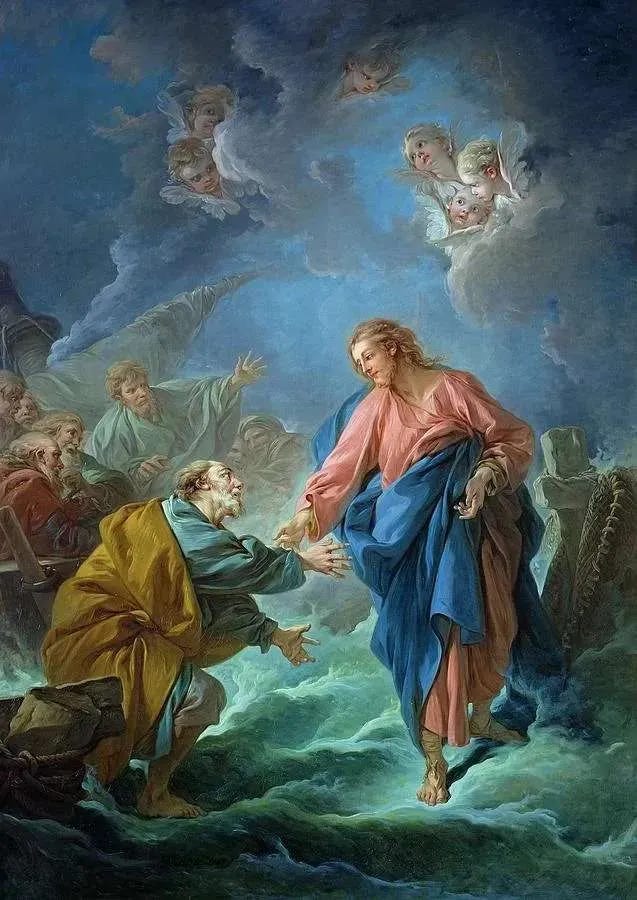
After the series of parables found in chapter 13, Matthew’s Gospel enters a new phase. In this one Jesus seems intent on having his followers gradually building an understanding of his true identity and purpose. Some commentators have proposed that Matthew’s Gospel is structured in five sections, reflecting the five books of the Torah (Pentateuch). The end of chapter 13 ushers in the third of these sections. The story of the storm on the lake is preceded by the feeding of the five thousand and the brutal death of John the Baptist. These two stories reflect both the miraculous and the terrifying, two dimensions that will come together in the story of the storm on the lake.
The disciples are sent out on the boat on their own. Jesus remains behind to pray. The day turns to night and the storm builds on the lake. The darkness and the storm together are portents of chaos and evil. The image of the boat in the storm is a frequently used symbol for the Church under persecution. The disciples are fearful and even when Jesus appears, walking on the water, they are in despair. Peter alone responds when Jesus calls out to them. He uses the title ‘Lord’ (Mt 14:28) which reveals the post-resurrection understanding of Jesus’ identity. Peter, himself walking on the water at Jesus’ behest is once again afraid and calls out to Jesus ‘Lord! Save Me!’ (Mt 14:30) a cry which aligns Jesus’ actions with the saving work of God. Jesus holds on to Peter and as they return to the boat, the storm subsides, the danger has passed and those present worship Jesus as the ‘Son of God’ (Mt 14:33).
Gospel Text: Matthew 14:22-33
Jesus made the disciples get into the boat and go on ahead to the other side while he would send the crowds away. After sending the crowds away he went up into the hills by himself to pray. When evening came, he was there alone, while the boat, by now far out on the lake, was battling with a heavy sea, for there was a head-wind. In the fourth watch of the night he went towards them, walking on the lake, and when the disciples saw him walking on the lake they were terrified. ‘It is a ghost’ they said, and cried out in fear. But at once Jesus called out to them, saying, ‘Courage! It is I! Do not be afraid.’ It was Peter who answered. ‘Lord,’ he said ‘if it is you, tell me to come to you across the water.’ ‘Come’ said Jesus. Then Peter got out of the boat and started walking towards Jesus across the water, but as soon as he felt the force of the wind, he took fright and began to sink. ‘Lord! Save me!’ he cried. Jesus put out his hand at once and held him. ‘Man of little faith,’ he said ‘why did you doubt?’ And as they got into the boat the wind dropped. The men in the boat bowed down before him and said, ‘Truly, you are the Son of God.’
See
What is Jesus doing before he comes to the disciples on the lake?
How does the storm, in the darkness of the night, impact on the disciples?
What do we learn from Peter’s experience of walking on the water with Jesus?
Judge
What circumstances present as ‘storms’ in our own experience?
What is the impact of fear on ourselves?
How does faith in Jesus affect our disposition when facing ‘storms’ on our own lives?
Act
What can we do to remain assured when faced with significant challenges?
How can our community of faith provide support to those who are experiencing challenging times?
What steps can be taken to ensure all people are welcome and supported in our community?
Image: https://christian.art/daily-gospel-reading/matthew-14-22-36-2022/
Gospel Text https://www.universalis.com/Australia/1100/mass.htm
Further Reading: