

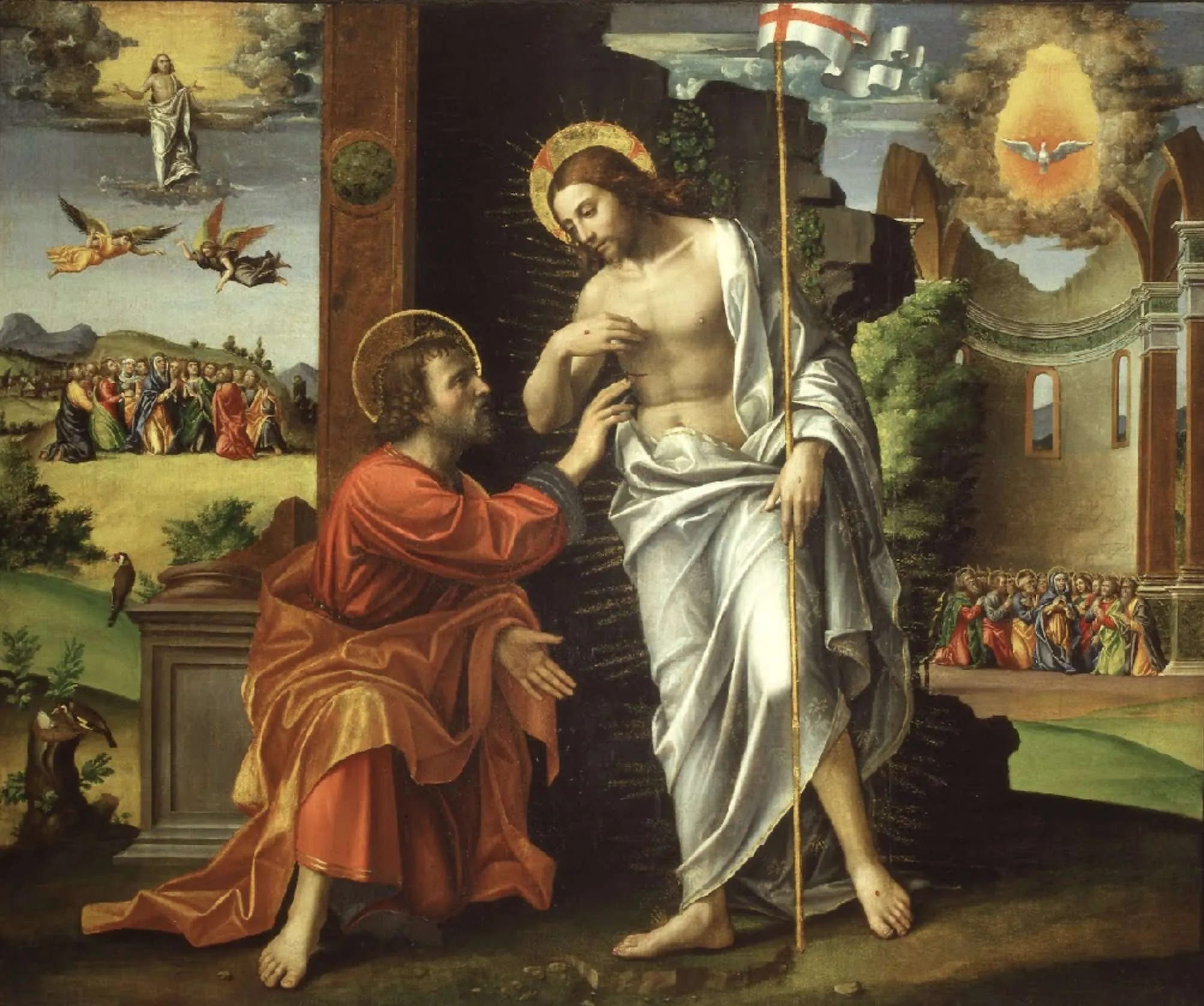
The first Sunday after the Feast of Easter is known as Divine Mercy Sunday. It comes with a focus on the forgiveness of God and calls upon followers to repent and seek forgiveness. The Gospel account, from the fourth Gospel, is set on two consecutive Sundays, the first is the evening of the day of the resurrection, the second, eight days later. The first scene finds the disciples in hiding for fear that they would suffer the same fate of Jesus, at the hands of the religious authorities. Jesus appears among them, despite the locked doors, indicating the risen Lord is not subject to the same physical constraints as the human Jesus. The presence of the risen Jesus brings an immediate sense of joy among the disciples. He greets them twice with the powerful words ‘Peace be with you’ before commissioning them and bestowing the Spirit upon them. The disciple Thomas, absent from the first scene and sceptical of reports of Jesus’ appearance is, subsequently present, eight days later when Jesus again greets the disciples with peace.
The notion of peace, repeated three times in Jesus’ greetings, is a central notion of Christianity. St Benedict, quoting from the Psalms, urged his community to ‘seek peace and pursue it’ RB Prol, PS 34:14. It has been a frequent theme of Christian writers throughout the centuries and has become a most urgent message from Popes of recent decades, as the capacity for warfare to destroy all of God’s creation has become so apparent. Pope Leo recently wrote “peace is a principle that guides and defines our choices” https://www.vatican.va/content/leo-xiv/en/messages/peace/documents/20251208-messaggio-pace.html highlighting the importance action in pursuit of peace. Peace activists have regularly used the aphorism ‘what if peace is a verb’. Recently, Nigerian poet and spoken word artist Maryam Bukar Hassan popularized the concept of expressing peace as a verb in her 2025 performance ‘Peace is a Verb’. This concept of peace has much to offer today, forcing us to consider peace as an active step, a deliberate strategy and a purposeful plan.
Gospel Text: John 20:19-29
In the evening of that same day, the first day of the week, the doors were closed in the room where the disciples were, for fear of the Jews. Jesus came and stood among them. He said to them, ‘Peace be with you’, and showed them his hands and his side. The disciples were filled with joy when they saw the Lord, and he said to them again, ‘Peace be with you.
‘As the Father sent me,
so am I sending you.’
After saying this he breathed on them and said:
‘Receive the Holy Spirit.
For those whose sins you forgive,
they are forgiven;
for those whose sins you retain,
they are retained.’
Thomas, called the Twin, who was one of the Twelve, was not with them when Jesus came. When the disciples said, ‘We have seen the Lord’, he answered, ‘Unless I see the holes that the nails made in his hands and can put my finger into the holes they made, and unless I can put my hand into his side, I refuse to believe.’ Eight days later the disciples were in the house again and Thomas was with them. The doors were closed, but Jesus came in and stood among them. ‘Peace be with you’ he said. Then he spoke to Thomas, ‘Put your finger here; look, here are my hands. Give me your hand; put it into my side. Doubt no longer but believe.’ Thomas replied, ‘My Lord and my God!’ Jesus said to him:
‘You believe because you can see me.
Happy are those who have not seen and yet believe.’
There were many other signs that Jesus worked and the disciples saw, but they are not recorded in this book. These are recorded so that you may believe that Jesus is the Christ, the Son of God, and that believing this you may have life through his name.
See
How is the risen Jesus portrayed in this text?
What does the text say about belief, in the episode with Thomas?
When does the greeting of peace occur in the text?
Judge
What significance can be drawn from Jesus’ commissioning of the disciples and bestowing the Holy Spirit immediately after his greeting of peace?
How do we see the relationship between forgiveness and peace in our own lives?
How does the ‘motif’ of peace, in this text, speak to the current situation in our world?
Act
What steps can we take to bring peace into our own life situations?
What possibilities are within our spheres of influence to bring peace in to the lives of others?
How can we use our personal choices to further the cause of peace in our world?
Image: https://christian.art/daily-gospel-reading/john-20-19-31-2024
Gospel Text https://www.universalis.com/Australia/1100/mass.htm
Further Reading:
https://mbfallon.com/matthew.html
https://ncec.catholic.edu.au/faith/scripture-resources/
https://www.vatican.va/content/leo-xiv/en/messages/peace/documents/20251208-messaggio-pace.html