

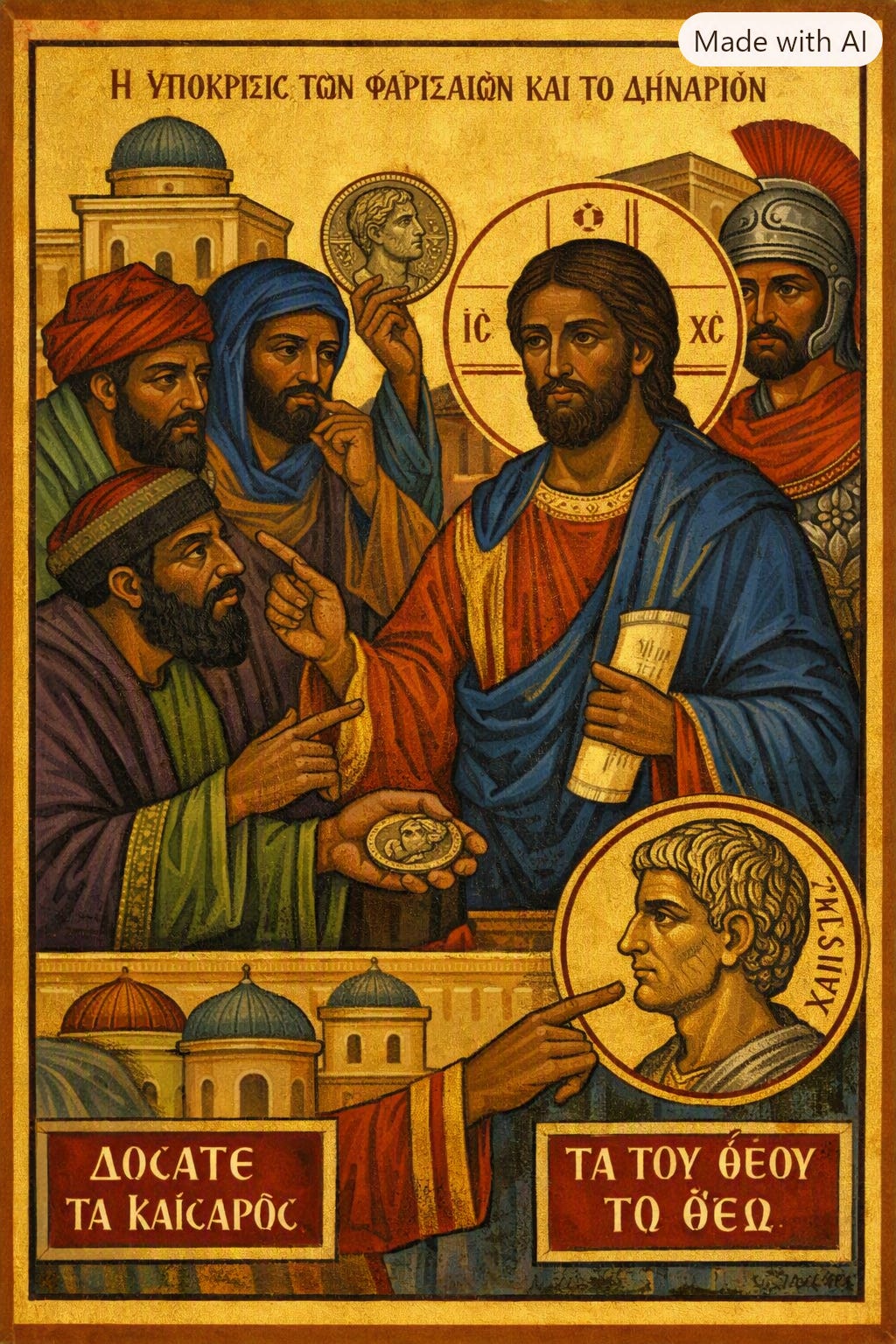
The Sunday Gospel for October 18 presents the account of yet another clash between Jesus’ ministry and the religious elite of the times. The previous two Sundays have featured parables directed towards the ‘chief priests and elders of the people’ (Mt 22:1). On this occasion it is the ‘Pharisees…together with the Herodians’ (Mt 22:15-16) who engage with Jesus. Commentators tells us that the Pharisees, who often feature in conflict with Jesus, only became prominent after the destruction of the Temple in 70CE. Thus, the conflict depicted in the Gospels is, more likely, reflective of conflicts evident in the late first century, about 50 years after Jesus’ life and ministry. The Herodians are less well known, being mentioned twice only in the Gospel of Mark, apart from this singular reference in Matthew. On each occasion they are shown to be in league with the Pharisees, in opposition to Jesus. While little is known about them, it is assumed, on the basis of the name, that they were collaborators, or at least sympathisers, with the occupying Roman forces.
The question posed to Jesus is, of course, a trick question. It focuses on the hated requirement of paying taxes to the occupying Romans. If Jesus was to speak against this, it would frame him as inciting opposition to the Roman authorities. If he spoke in support of the tax he could be accused of disloyalty to his own Jewish heritage. Jesus first calls out their insincerity then cuts to the crux of the issue. All that matters is that we live and act according to God’s kingdom. Giving ‘to God what belongs to God’ (Mt 22:21) which, of course, is everything that brings life. The other part of the answer ‘give back to Caesar what belongs to Caesar’ (Mt 22:21) should be understood not as an endorsement of the tax but as a call for the Pharisees and Herodians to let go of the power and influence they have gained under the protection of the Romans, a power which, in many instances, contributes directly to the oppression of the Jewish people. Rather than enjoying the privileges of their status, they should turn away from such things and truly focus on ‘what belongs to God’ (Mt 22:21).
Gospel Text: Matthew 22:15-21
The Pharisees went away to work out between them how to trap Jesus in what he said. And they sent their disciples to him, together with the Herodians, to say, ‘Master, we know that you are an honest man and teach the way of God in an honest way, and that you are not afraid of anyone, because a man’s rank means nothing to you. Tell us your opinion, then. Is it permissible to pay taxes to Caesar or not?’ But Jesus was aware of their malice and replied, ‘You hypocrites! Why do you set this trap for me? Let me see the money you pay the tax with.’ They handed him a denarius, and he said, ‘Whose head is this? Whose name?’ ‘Caesar’s’ they replied. He then said to them, ‘Very well, give back to Caesar what belongs to Caesar – and to God what belongs to God.’
See
What is the ultimate purpose of the question posed to Jesus by the disciples of the Pharisees and Herodians?
What dilemma does this create for Jesus?
How does Jesus answer the question?
Judge
Jesus calls out the questioners as hypocrites. Why is this important in his answer to their question?
What does the passage convey about integrity on the part of Jesus and on the part of the questioners?
What do we understand by the phrase to ‘and to God, what belongs to God’ (Mt 22:21)?
Act
How can I ensure that I act with integrity in my own life situation?
What steps can we take to give to God what belongs to God our own life situations?
What possibilities are within our spheres of influence to do this in to the lives of others?
Image https://copilot.microsoft.com/chats/acvvpCZ3cjPqzgBJ7xSsE
Gospel Text https://www.universalis.com/Australia/1100/mass.htm
Further Reading: