

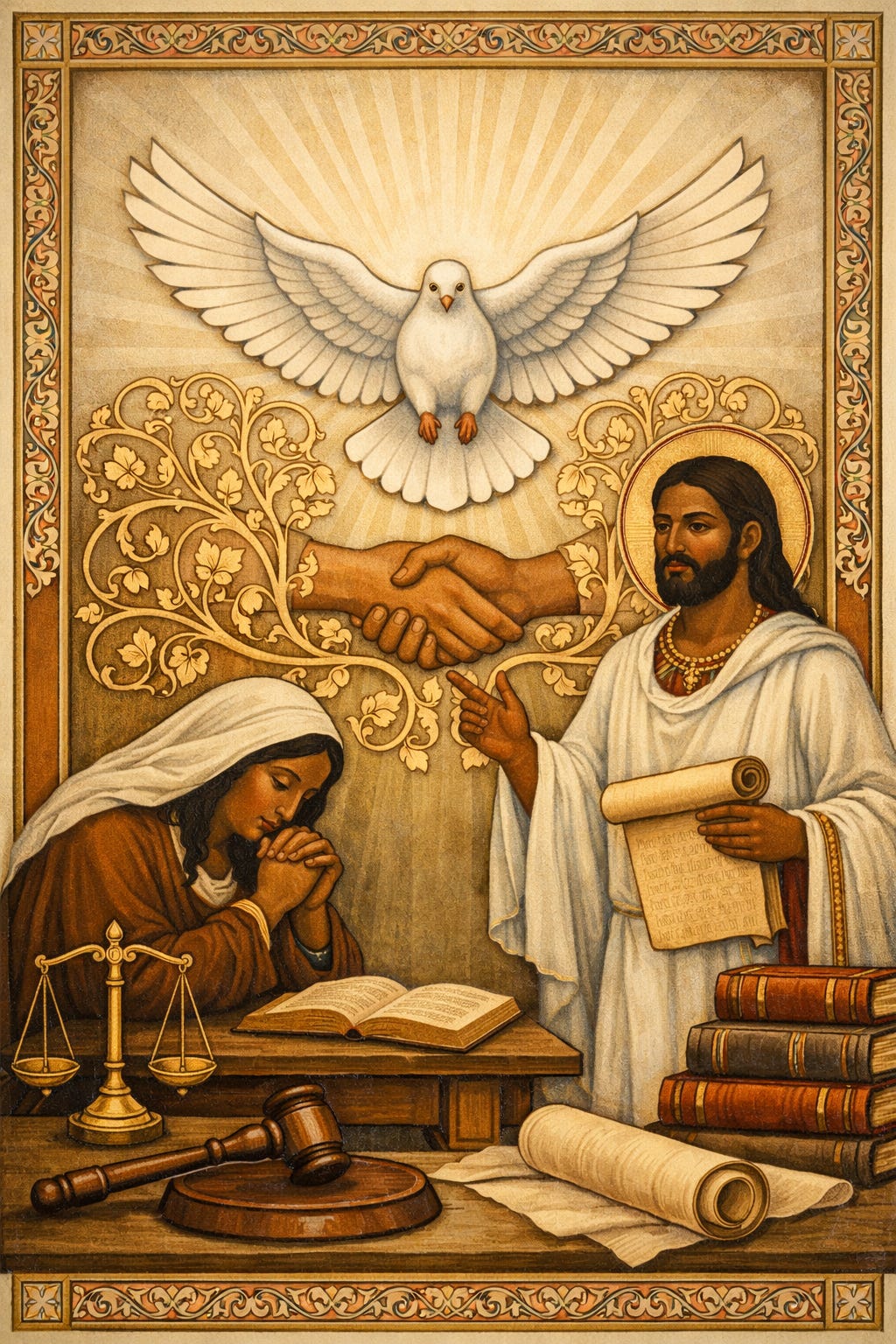
This text, from the Liturgy of the Sixth Sunday of Easter, is part of a long discourse in John’s Gospel, from the setting of the Last Supper. It is a discourse replete with assurances from Jesus that he will not abandon his disciples such as: ‘I will not leave you orphans, I will come back to you’ (Jn 14:18). It is also a discourse which focuses strongly on the Holy Spirit, ‘the Advocate’ (Jn 14:16) and the theme of love. Rather than calling for belief from the disciples Jesus asks them to love him, and to keep his commandments (Jn 14:15 & 21). The motif of the Spirit has been prominent in earlier parts of the Gospel including at Jesus’ baptism (Jn 1:32-33), in the encounter with Nicodemus (Jn 3:5-8) and in the image of living water with the Samaritan Women (Jn 4:10-14). Now, in the Last Supper discourse, it takes centre stage.
The Holy Spirit, in this text, is given two titles, ‘the advocate’ (Jn 14:16) and ‘the Spirit of truth’ (Jn 14:17). The meanings behind these two titles shapes the understanding of the Holy Spirit and invites reflection on the role of the Spirit in contemporary discipleship. Many claim that their discipleship is guided by this Spirit of Truth, however, the true test of this claim is in the Gospel text ‘if you love me you will keep my commandments’ (Jn 14:15) and the fundamental commandment given in the previous chapter ‘love one another, as I have loved you so you must love one another’ (Jn 13:34). If love for one another is present, then surely, that discipleship bears the imprint of the Spirit of Truth
Gospel Text: John 14:15-21
Jesus said to his disciples:
‘If you love me you will keep my commandments.
I shall ask the Father,
and he will give you another Advocate
to be with you for ever,
that Spirit of truth
whom the world can never receive
since it neither sees nor knows him;
but you know him,
because he is with you, he is in you.
I will not leave you orphans;
I will come back to you.
In a short time the world will no longer see me;
but you will see me,
because I live and you will live.
On that day you will understand that I am in my Father
and you in me and I in you.
Anybody who receives my commandments and keeps them
will be one who loves me;
and anybody who loves me will be loved by my Father,
and I shall love him and show myself to him.’
See
What do we understand by the use of the terms ‘Advocate’ and ‘Spirit of Truth’ to refer to the Holy Spirit in this text?
What examples of discipleship can we see that are clearly reflective of love of God and love of one another?
Where can we see claims of discipleship which seem to be at odds with love of God and love of one another?
Judge
In our contemporary experience, what does it mean to show love, as Jesus called for from his disciples?
How do we understand the role of the Spirit in this Gospel text?
How do we see the relationship between the Spirit, love and discipleship in this text?
Act
What steps can I take to be more receptive to the urging of the Holy Spirit in my own life?
What can I do to show love to those people that I simply do not like?
How can I allow the Spirit be ‘advocate’ through my own spheres of influence?
Image: https://copilot.microsoft.com/chats/AKccC1nvNY8CKgXSS2LEH
Gospel Text https://www.universalis.com/Australia/1100/mass.htm
Further Reading: