

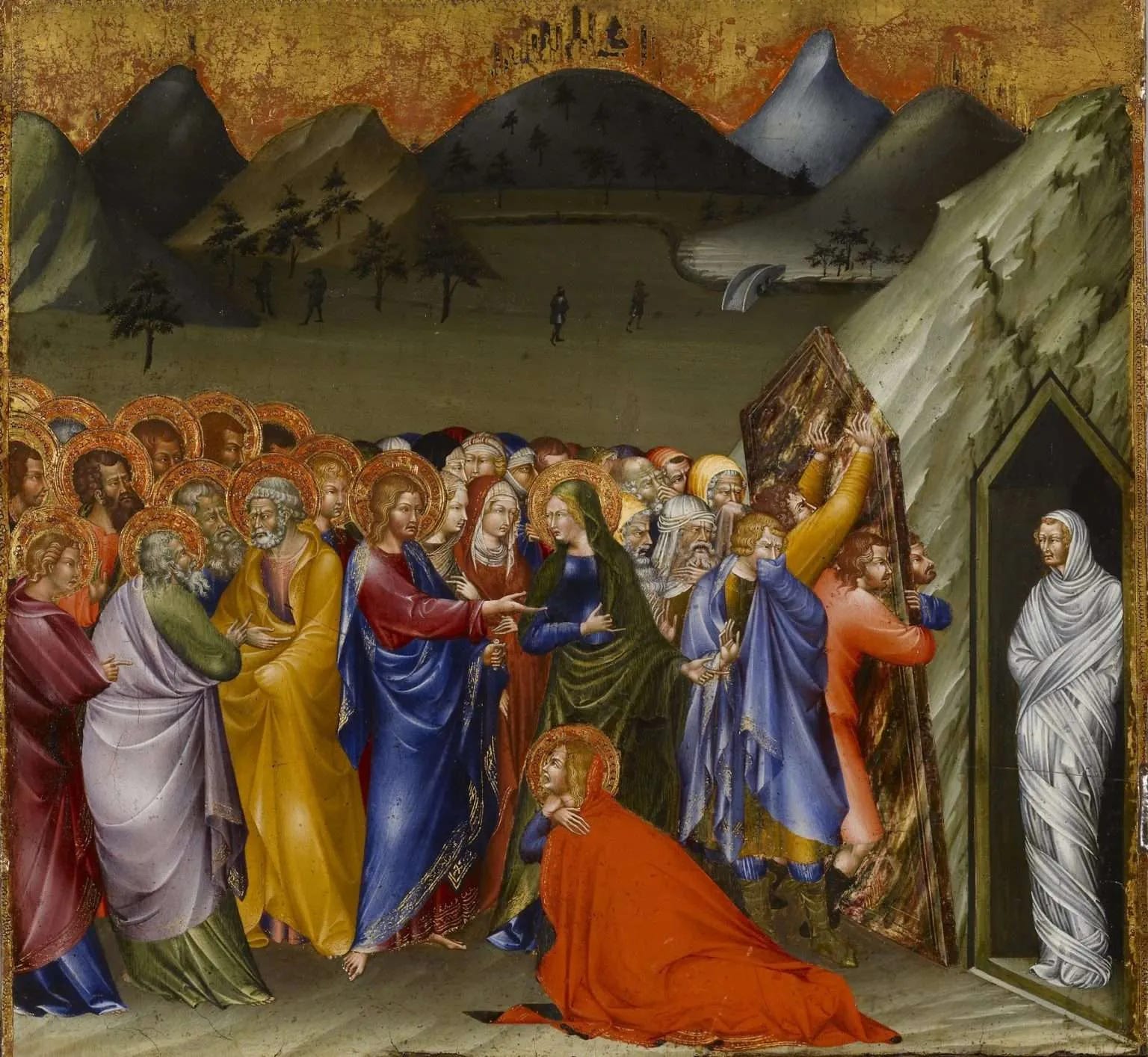
Characterised by errors of geography and continuity, the Johannine account of the raising of Lazarus from the dead is a somewhat peculiar text. Many commentators suggest that it was a later addition, by a scribe unfamiliar with the geography of Jerusalem and its surrounds, as well as the narrative sequence of the fourth Gospel. The event of raising Lazarus from the dead is referred to as a ‘sign’ rather than a ‘miracle’ by the author. It is the last of seven such ‘signs’ found in John’s Gospel. The others are: the wedding at Cana - changing water into wine (2:1–11), healing the official’s son (4:46–54), healing the paralytic at Bethesda (5:1–15), feeding the 5,000 (6:5–14), walking on water (6:16–24) and healing the man born blind (9:1–7)
The text wrestles with the concept of resurrection, drawing together three strands. First, the Jewish expectation that the dead will rise on the last day, second, the notion that Jesus has the power to raise the dead and third, a foreshadowing of Jesus’ own resurrection. The ‘sign’ of raising Lazarus points to the glory of God, manifest in Jesus and the power to overcome all things, even death.
The setting of the story is the town of Bethany, close to the city of Jerusalem. The word ‘Bethany’ means place, or house, of the poor. Lazarus is a figure unique to this story in John’s Gospel, he is conspicuously absent in the synoptic Gospel stories of the household of Martha and Mary in Bethany and is not mentioned elsewhere in the Gospel of John. The name ‘Lazarus’ means God is my help.
The motifs of belief and hope are threaded through the text with six explicit occurrences and a constant undertone evident in the actions of Jesus as well of those of Mary and Martha. As with many other Gospel texts, the texts culminates with those present being moved to believe in Jesus.
Gospel text: John 11:1-45
There was a man named Lazarus who lived in the village of Bethany with the two sisters, Mary and Martha, and he was ill. It was the same Mary, the sister of the sick man Lazarus, who anointed the Lord with ointment and wiped his feet with her hair. The sisters sent this message to Jesus, ‘Lord, the man you love is ill.’ On receiving the message, Jesus said, ‘This sickness will end not in death but in God’s glory, and through it the Son of God will be glorified.’
Jesus loved Martha and her sister and Lazarus, yet when he heard that Lazarus was ill he stayed where he was for two more days before saying to the disciples, ‘Let us go to Judaea.’ The disciples said, ‘Rabbi, it is not long since the Jews wanted to stone you; are you going back again?’ Jesus replied:
‘Are there not twelve hours in the day?
A man can walk in the daytime without stumbling
because he has the light of this world to see by;
but if he walks at night he stumbles,
because there is no light to guide him.’
He said that and then added, ‘Our friend Lazarus is resting, I am going to wake him.’ The disciples said to him, ‘Lord, if he is able to rest he is sure to get better.’ The phrase Jesus used referred to the death of Lazarus, but they thought that by ‘rest’ he meant ‘sleep’, so Jesus put it plainly, ‘Lazarus is dead; and for your sake I am glad I was not there because now you will believe. But let us go to him.’ Then Thomas – known as the Twin – said to the other disciples, ‘Let us go too, and die with him.’
On arriving, Jesus found that Lazarus had been in the tomb for four days already. Bethany is only about two miles from Jerusalem, and many Jews had come to Martha and Mary to sympathise with them over their brother. When Martha heard that Jesus had come she went to meet him. Mary remained sitting in the house. Martha said to Jesus, ‘If you had been here, my brother would not have died, but I know that, even now, whatever you ask of God, he will grant you.’ ‘Your brother’ said Jesus to her ‘will rise again.’ Martha said, ‘I know he will rise again at the resurrection on the last day.’ Jesus said:
‘I am the resurrection and the life.
If anyone believes in me, even though he dies he will live,
and whoever lives and believes in me will never die.
Do you believe this?’
‘Yes, Lord,’ she said ‘I believe that you are the Christ, the Son of God, the one who was to come into this world.’
When she had said this, she went and called her sister Mary, saying in a low voice, ‘The Master is here and wants to see you.’ Hearing this, Mary got up quickly and went to him. Jesus had not yet come into the village; he was still at the place where Martha had met him. When the Jews who were in the house sympathising with Mary saw her get up so quickly and go out, they followed her, thinking that she was going to the tomb to weep there.
Mary went to Jesus, and as soon as she saw him she threw herself at his feet, saying, ‘Lord, if you had been here, my brother would not have died.’ At the sight of her tears, and those of the Jews who followed her, Jesus said in great distress, with a sigh that came straight from the heart, ‘Where have you put him?’ They said, ‘Lord, come and see.’ Jesus wept; and the Jews said, ‘See how much he loved him!’ But there were some who remarked, ‘He opened the eyes of the blind man, could he not have prevented this man’s death?’ Still sighing, Jesus reached the tomb: it was a cave with a stone to close the opening. Jesus said, ‘Take the stone away.’ Martha said to him, ‘Lord, by now he will smell; this is the fourth day.’ Jesus replied, ‘Have I not told you that if you believe you will see the glory of God?’ So they took away the stone. Then Jesus lifted up his eyes and said:
‘Father, I thank you for hearing my prayer.
I knew indeed that you always hear me,
but I speak for the sake of all these who stand round me,
so that they may believe it was you who sent me.’
When he had said this, he cried in a loud voice, ‘Lazarus, here! Come out!’ The dead man came out, his feet and hands bound with bands of stuff and a cloth round his face. Jesus said to them, ‘Unbind him, let him go free.’
Many of the Jews who had come to visit Mary and had seen what he did believed in him
See
Which characters in the story are shown as believing in Jesus?
Which characters in the story have an evident lack of belief?
How does hope influence the actions of Mary and Martha in this story?
Judge
Belief is often closely related to hope. Where is there need for hope in our world today?
In the Gospel account the actions of Jesus, Mary and Martha are important elements of their belief. What do these actions show?
The situation confronting Mary and Martha would often lead to despair. What can we learn from their response to this situation?
Act
What things can I do, to strengthen my own belief?
What can I do to help strengthen the belief of others?
What steps can I take to provide hope when it is needed?
Image: John 11: 3-7,17,20-27,33-45 (2023) | CHRISTIAN ART | Gospel Reading & Art Reflection
Gospel Text https://www.universalis.com/Australia/1100/mass.htm
Further Reading: