

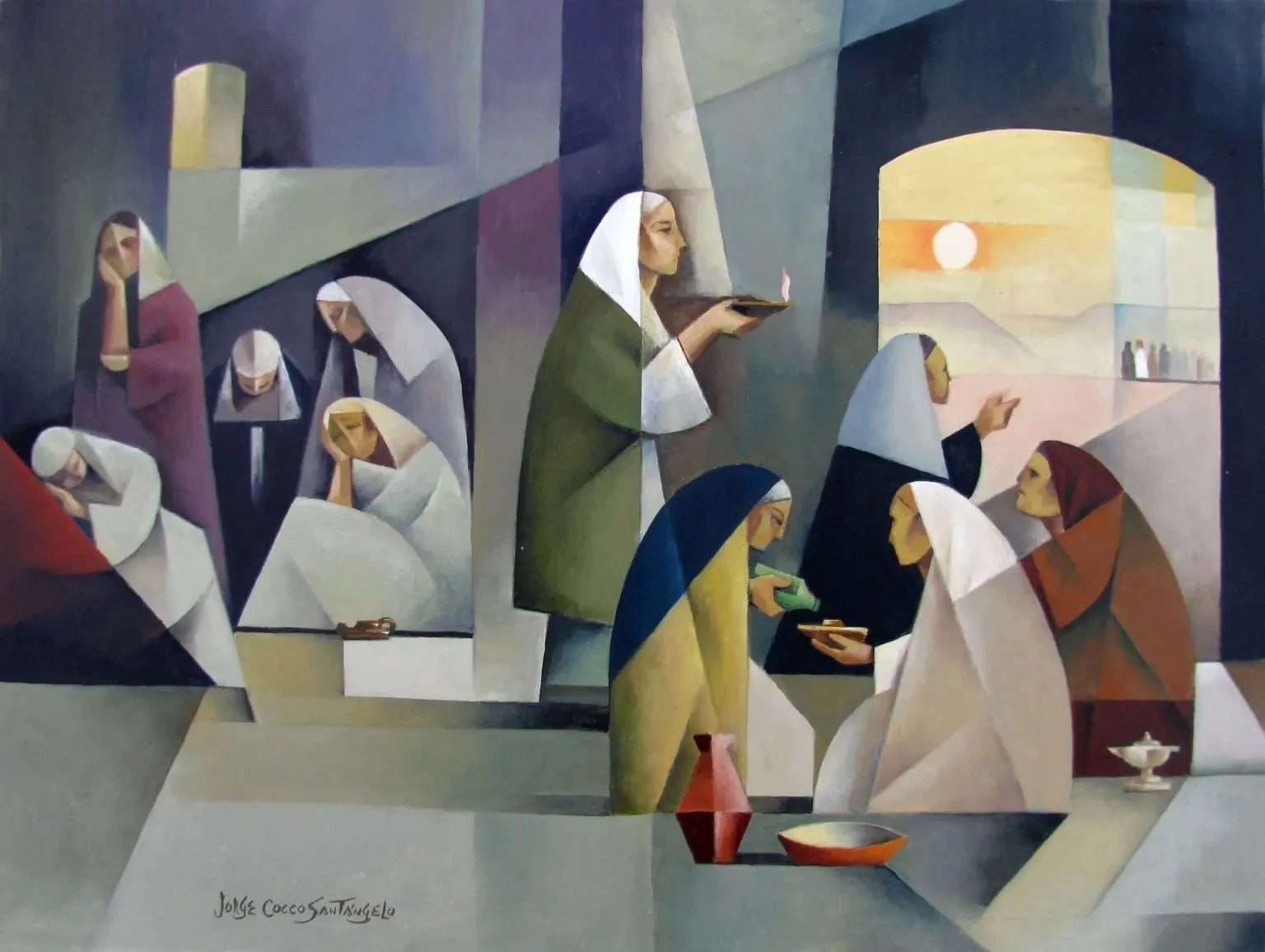
The parable of the ten bridesmaids heralds the last of Matthew’s chapters before the passion narrative commences. This chapter contains three parables, all focusing on the final judgement at the end time. The parable of the ten bridesmaids highlights the need to be prepared accompanied by the notion that the final days will come unexpectedly. The group of bridesmaids are represented in two groups. The five who were foolish and the five who were sensible (Mt 25:2). The evidence of their wisdom, or lack thereof, is in the step of planning ahead and bringing extra oil for their lamps to allow for the contingency of the bridegroom being delayed. The consequence of being unprepared, in this parable, is to be locked out of the wedding feast. Even their appeals to be let in go unheeded (Mt 25:11-12). The text concludes with the entreaty to ‘stay awake, because you do not know either the day or the hour’ (Mt 25:13).
Of the many area for reflection, arising from this text, it would be important to consider what it means to be prepared for the coming judgement at the end of time. While some fundamentalist traditions focus almost exclusively on this aspect, the Catholic tradition has always encouraged people to live with love, faith and integrity, at all times. The Catechism of the Catholic Church, referencing St John of the Cross, reminds us that “at the evening of life we shall be judged on our love” (Catechism of the Catholic Church, §1022). Would knowing the ‘day or the hour’ (Mt 25:13) of the coming judgement cause us to do anything differently in the intervening period? If so, then perhaps it leads us to question these aspects of how we are living today.
Gospel Text: Matthew 25:1-13
Jesus told this parable to his disciples: ‘The kingdom of heaven will be like this: Ten bridesmaids took their lamps and went to meet the bridegroom. Five of them were foolish and five were sensible: the foolish ones did take their lamps, but they brought no oil, whereas the sensible ones took flasks of oil as well as their lamps. The bridegroom was late, and they all grew drowsy and fell asleep. But at midnight there was a cry, “The bridegroom is here! Go out and meet him.” At this, all those bridesmaids woke up and trimmed their lamps, and the foolish ones said to the sensible ones, “Give us some of your oil: our lamps are going out.” But they replied, “There may not be enough for us and for you; you had better go to those who sell it and buy some for yourselves.” They had gone off to buy it when the bridegroom arrived. Those who were ready went in with him to the wedding hall and the door was closed. The other bridesmaids arrived later. “Lord, Lord,” they said “open the door for us.” But he replied, “I tell you solemnly, I do not know you.” So stay awake, because you do not know either the day or the hour.’
See
How does the text differentiate between the foolish and sensible bridesmaids?
What is the consequence for the actions of the two groups of bridesmaids?
What message does Jesus include at the conclusion of the parable (Mt 25:13)?
Judge
What should be understand from the use of the wedding feast in relation to Gods’ kingdom?
What meaning might be taken from the delayed arrival of the bridegroom, in the parable?
How does this text relate to the idea the coming judgement, at the end of time?
Act
What would we do differently, in our lives, if we knew the time of the coming judgement?
What actions should we take to ensure that our lives are lived with love, faith and integrity?
What actions can we take to influence those, within our spheres of influence, to live their lives according to God’s kingdom?
Image https://christian.art/daily-gospel-reading/matthew-25-1-13-2024-2
Gospel Text https://www.universalis.com/Australia/1100/mass.htm
Further Reading: