

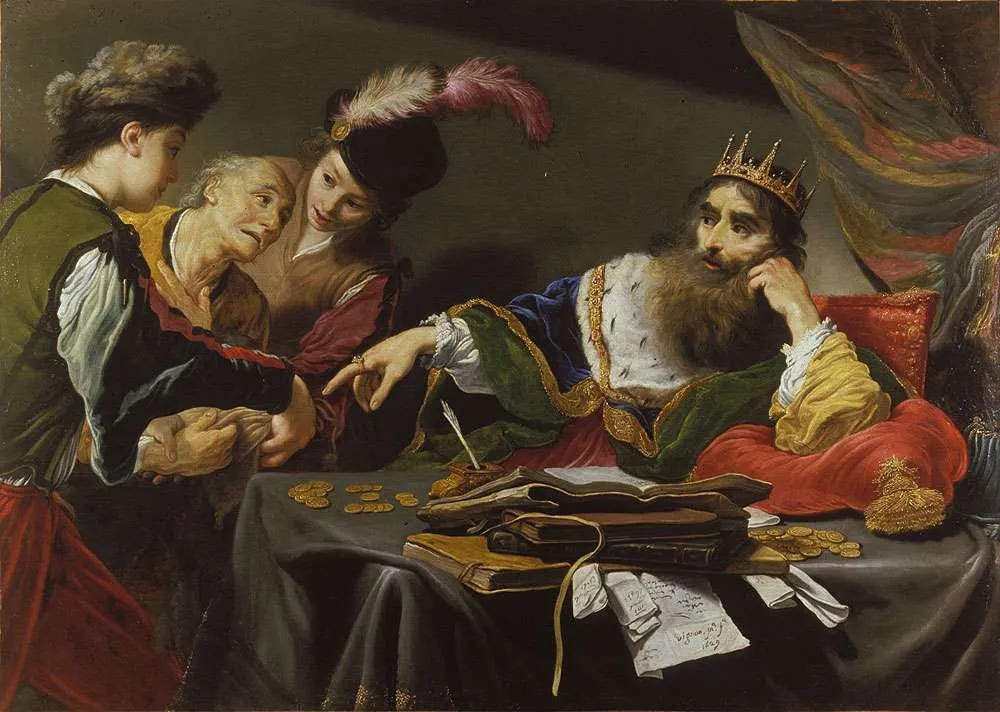
This Gospel passage is found in a section of Matthew’s text where Jesus constantly highlights the loving, merciful and forgiving nature of God. Such an emphasis is a strong reassurance to the audience that God will always love and forgive them, regardless of their failings. Here, we are presented with another parable in simple allegorical form. As is often the case, the scene is set with a question to Jesus. In this instance, Peter asks about forgiveness for wrong done against him (Mt 18:21). How many times must he forgive? Peter volunteers the number seven, a generous amount indeed. Jesus counters with hyperbole, seventy-seven times (or seventy times seven in some translations). The number is not important, rather it is the contrast to Peter’s seven time which, in fairness, seems like a significant amount. However, Jesus’ reply highlights the limitless capacity of God’s love.
The parable that follows tells a dramatic tale of forgiveness and violent punishment. The debt owed by the first servant is an incredible amount, many time the amount a labourer could hope to earn in their entire lifetime. It is a huge debt and the act of forgiveness in cancelling the debt is extraordinary in its generosity. The episode with the second servant gets to the crux of the matter. While the first servant begged the King to forgive him, he showed no such mercy towards his fellow servant. Such hypocrisy is abhorrent in God’s eyes. The conclusion of the parable is troubling in its violence. A dramatic way to highlight consequences of the lack of integrity on the part of the first servant.
Gospel Text: Matthew 18:21-35
Peter went up to Jesus and said, ‘Lord, how often must I forgive my brother if he wrongs me? As often as seven times?’ Jesus answered, ‘Not seven, I tell you, but seventy-seven times.
‘And so the kingdom of heaven may be compared to a king who decided to settle his accounts with his servants. When the reckoning began, they brought him a man who owed ten thousand talents; but he had no means of paying, so his master gave orders that he should be sold, together with his wife and children and all his possessions, to meet the debt. At this, the servant threw himself down at his master’s feet. “Give me time” he said “and I will pay the whole sum.” And the servant’s master felt so sorry for him that he let him go and cancelled the debt. Now as this servant went out, he happened to meet a fellow servant who owed him one hundred denarii; and he seized him by the throat and began to throttle him. “Pay what you owe me” he said. His fellow servant fell at his feet and implored him, saying, “Give me time and I will pay you.” But the other would not agree; on the contrary, he had him thrown into prison till he should pay the debt. His fellow servants were deeply distressed when they saw what had happened, and they went to their master and reported the whole affair to him. Then the master sent for him. “You wicked servant,” he said “I cancelled all that debt of yours when you appealed to me. Were you not bound, then, to have pity on your fellow servant just as I had pity on you?” And in his anger the master handed him over to the torturers till he should pay all his debt. And that is how my heavenly Father will deal with you unless you each forgive your brother from your heart.
See
What is evident in Jesus’ response to Peter’s question about forgiving seven times?
What does the parable show about the first servant’s integrity?
What meaning is conveyed in the text where the King says ‘Were you not bound, then, to have pity on your fellow servant just as I had pity on you?’ (Mt 18:33)
Judge
What characteristics of God are depicted in this text?
What does the text suggest about mercy and forgiveness in our current context?
How do we understand the emphasis on personal integrity in this passage?
Act
How can I act to ensure that I am offering forgiveness to those who have wronged me?
How can I act to seek forgiveness when I have wronged others?
What steps can I take to ensure that I act with integrity in my dealings with others?
Image: https://christian.art/daily-gospel-reading/matthew-18-21-19-1-2025/
Gospel Text https://www.universalis.com/Australia/1100/mass.htm
Further Reading: