

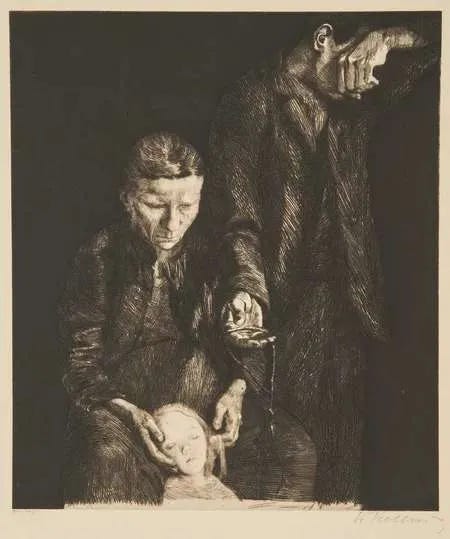
This Gospel text begins with an expression of Jesus’ compassion for the people in their suffering. In earlier chapters of the Gospel it is Jesus himself who responds to this suffering through his ministry of healing (Mt 4:23, 8:3, 9:33). Now, it is the turn of the apostles to continue this ministry, just as they had observed, while following Jesus. The text includes the often quoted reflection on Mission that ‘the harvest is rich but the labourers are few’ (Mt 9:37). The Mission of the disciples is to be twofold – proclaiming that the Kingdom of God is close at hand, just as Jesus had done at the beginning of his ministry (Mt 4:17), and healing the sick, cleansing lepers etc. which had also been central to Jesus’ ministry.
One of Matthew’s key concerns, in writing this Gospel, seems to have been to show that Jesus truly is the Messiah (Christ) promised to the people of Israel. This is often done through quoting texts from the Hebrew Scriptures as being fulfilled in the life and ministry of Jesus. In this Gospel text, there are two echoes of that motif. First, the naming of the twelve apostles, with the number twelve symbolically corresponding with the twelve tribes of Israel. Second, the instruction to go only to the ‘lost sheep of the House of Israel’ (Mt:10;6) rather than the territory of the Gentiles or Samaritans. Underlining the privileged position of the people of Israel to be given the Messiah is a strong indication of Matthew’s purpose. This restriction on the mission of the apostles seems to be at odds with the evident practice of Jesus and his disciples and, most notably with the final commissioning of the disciples where they are told to ‘make disciples of all nations’ (Mt 28:19).
Gospel Text: Matthew 9:36-10:8
When Jesus saw the crowds he felt sorry for them because they were harassed and dejected, like sheep without a shepherd. Then he said to his disciples, ‘The harvest is rich but the labourers are few, so ask the Lord of the harvest to send labourers to his harvest.’
He summoned his twelve disciples, and gave them authority over unclean spirits with power to cast them out and to cure all kinds of diseases and sickness.
These are the names of the twelve apostles: first, Simon who is called Peter, and his brother Andrew; James the son of Zebedee, and his brother John; Philip and Bartholomew; Thomas, and Matthew the tax collector; James the son of Alphaeus, and Thaddaeus; Simon the Zealot and Judas Iscariot, the one who was to betray him. These twelve Jesus sent out, instructing them as follows:
‘Do not turn your steps to pagan territory, and do not enter any Samaritan town; go rather to the lost sheep of the House of Israel. And as you go, proclaim that the kingdom of heaven is close at hand. Cure the sick, raise the dead, cleanse the lepers, cast out devils. You received without charge, give without charge.’
See
What does the commissioning of the apostles suggest about Jesus’ approach to his mission?
Before commissioning the apostles, Jesus is affected by the situation of the crowds. How does his compassion for their plight influence his actions?
Jesus likens the crowds to ‘sheep without a shepherd’. What does this observation suggest about the religious leaders in their community?
Judge
Who, in our own world, are the labourers who are being called to the harvest?
Who, in our society today, are ‘harassed and dejected’ and in need of our compassion?
Who, in today’s world, are failing to be a ‘shepherd’ to those who are harassed and rejected?
Act
What actions am I called to in bringing God’s Kingdom to fruition in my own circumstances?
How do I help others recognise that God’ Kingdom is near to them?
How can I engage others in works of healing and compassion?
Image: https://christian.art/daily-gospel-reading/matthew-9-35-10-1-5a-6-8-2024/
Gospel Text https://www.universalis.com/Australia/1100/mass.htm
Further Reading: