

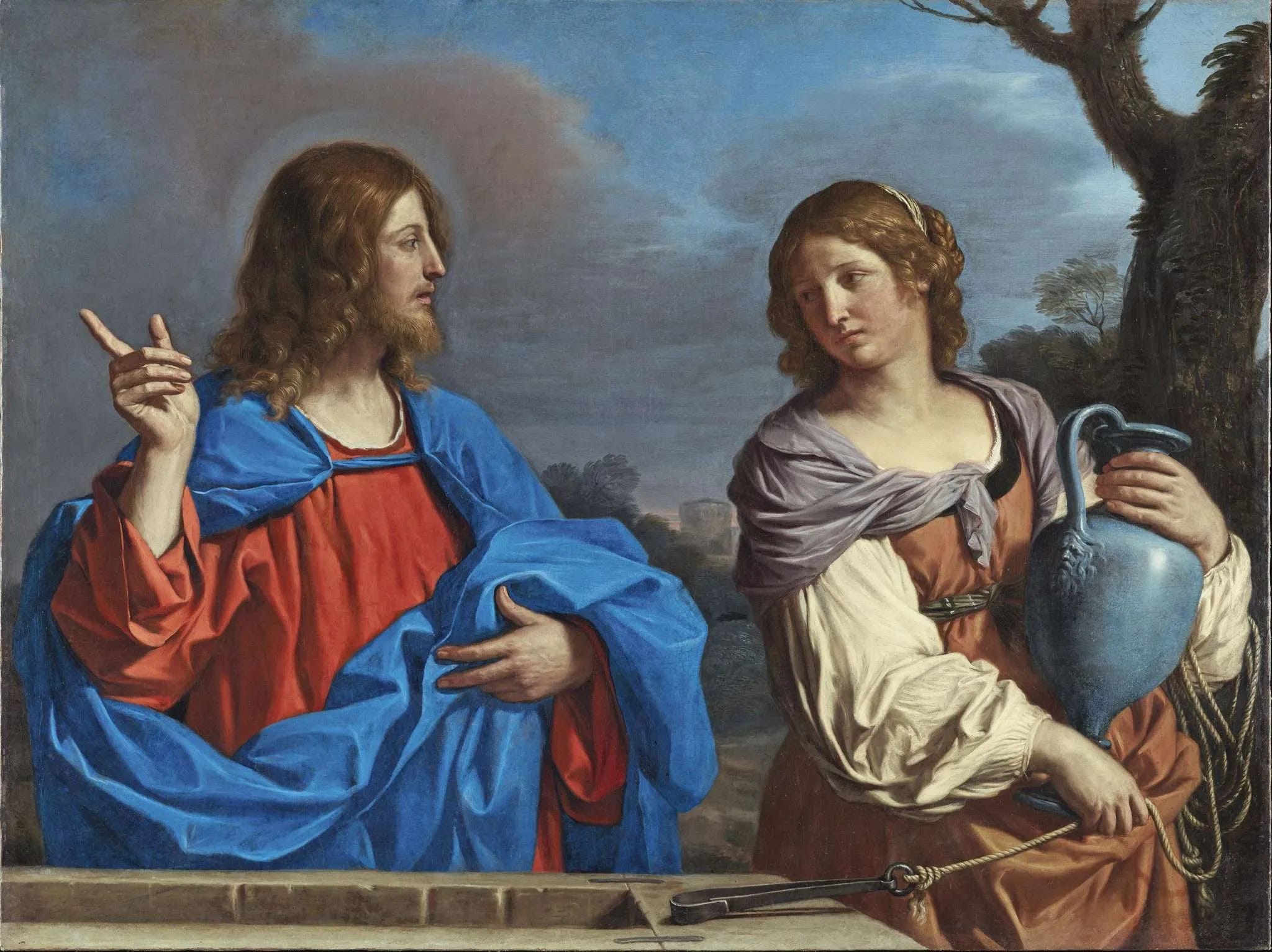
The full text of the Gospel for the Third Sunday of Lent is a lengthy one indeed, encompassing almost forty versus of John’s fourth chapter. The text is replete with rich and complex themes that would take many volumes to explore. One of the themes, less frequently discussed, is the encounter between the Jewish Jesus and the anonymous Samaritan woman. The Samaritan people were close cousins of their Jewish neighbours, however, the fall of Samaria, the capital of the Northern Kingdom in 722BCE and the subsequent deportation and reintegration of the population at the hands of the Assyrians led to a fracturing of the relationship between the Samaritans of the North and the Jews of the South. So deep was this rupture that, by the first century CE, there was deep enmity between Jews and Samaritans.
The rift between the Samaritans and Jews is reflected twice in the Gospel text, first at the surprise expressed by the woman that a Jew would approach her, a Samaritan, for a drink. Then again with the return of Jesus’ disciples as they puzzled at why Jesus would be speaking to this woman. As the account progresses, not only does the Samaritan woman become an unlikely disciple but she also goes to her own community and, becomes the catalyst for their conversion and for a previously improbable offer of hospitality.
Gospel Text John 4:5-42
Jesus came to the Samaritan town called Sychar, near the land that Jacob gave to his son Joseph. Jacob’s well is there and Jesus, tired by the journey, sat straight down by the well. It was about the sixth hour. When a Samaritan woman came to draw water, Jesus said to her, ‘Give me a drink.’ His disciples had gone into the town to buy food. The Samaritan woman said to him, ‘What? You are a Jew and you ask me, a Samaritan, for a drink?’ – Jews, in fact, do not associate with Samaritans. Jesus replied:
‘If you only knew what God is offering
and who it is that is saying to you:
Give me a drink, you would have been the one to ask,
and he would have given you living water.’
‘You have no bucket, sir,’ she answered ‘and the well is deep: how could you get this living water? Are you a greater man than our father Jacob who gave us this well and drank from it himself with his sons and his cattle?’ Jesus replied:
‘Whoever drinks this water
will get thirsty again;
but anyone who drinks the water that I shall give
will never be thirsty again:
the water that I shall give
will turn into a spring inside him,
welling up to eternal life.’
‘Sir,’ said the woman ‘give me some of that water, so that I may never get thirsty and never have to come here again to draw water.’ ‘Go and call your husband’ said Jesus to her ‘and come back here.’ The woman answered, ‘I have no husband.’ He said to her, ‘You are right to say, “I have no husband”; for although you have had five, the one you have now is not your husband. You spoke the truth there.’ ‘I see you are a prophet, sir’ said the woman. ‘Our fathers worshipped on this mountain, while you say that Jerusalem is the place where one ought to worship.’ Jesus said:
‘Believe me, woman,
the hour is coming
when you will worship the Father
neither on this mountain nor in Jerusalem.
You worship what you do not know;
we worship what we do know:
for salvation comes from the Jews.
But the hour will come
– in fact it is here already –
when true worshippers will worship the Father in spirit and truth:
that is the kind of worshipper the Father wants.
God is spirit,
and those who worship
must worship in spirit and truth.’
The woman said to him, ‘I know that Messiah – that is, Christ – is coming; and when he comes he will tell us everything.’ ‘I who am speaking to you,’ said Jesus ‘I am he.’
At this point his disciples returned, and were surprised to find him speaking to a woman, though none of them asked, ‘What do you want from her?’ or, ‘Why are you talking to her?’ The woman put down her water jar and hurried back to the town to tell the people. ‘Come and see a man who has told me everything I ever did; I wonder if he is the Christ?’ This brought people out of the town and they started walking towards him.
Meanwhile, the disciples were urging him, ‘Rabbi, do have something to eat; but he said, ‘I have food to eat that you do not know about.’ So the disciples asked one another, ‘Has someone been bringing him food?’ But Jesus said:
‘My food is to do the will of the one who sent me,
and to complete his work.
Have you not got a saying:
Four months and then the harvest?
Well, I tell you:
Look around you, look at the fields;
already they are white, ready for harvest!
Already the reaper is being paid his wages,
already he is bringing in the grain for eternal life,
and thus sower and reaper rejoice together.
For here the proverb holds good:
one sows, another reaps;
I sent you to reap a harvest you had not worked for.
Others worked for it;
and you have come into the rewards of their trouble.’
Many Samaritans of that town had believed in him on the strength of the woman’s testimony when she said, ‘He told me all I have ever done’, so, when the Samaritans came up to him, they begged him to stay with them. He stayed for two days, and when he spoke to them many more came to believe; and they said to the woman, ‘Now we no longer believe because of what you told us; we have heard him ourselves and we know that he really is the saviour of the world.’
See
Who are the people, today, who live with the consequences of fractured relationships of the past?
Who are the people, in my own circles, who are treated as outsiders?
What common traits of humanity, faith and community can I identify among those who I see as different to myself?
Judge
Jesus’ response to the Samaritan woman challenged the historical enmity between Samaritans and Jews. What does this tell us about historical enmity in today’s world?
What do I see, in the example of Jesus, regarding people who are different to myself?
The Samaritan woman becomes a bearer of the message of Christ to her own community. In what ways do those ‘outside’ my own faith community carry the message of Christ?
Act
The Samaritan community showed hospitality to Jesus and his disciples. How can I offer hospitality to those who I see as different to myself?
How can I support community endeavours to provide hospitality to marginalised people in my own context?
What can I initiate, to create a welcome space for those who may see themselves as outsiders in my own community/parish?
Image: https://christian.art/daily-gospel-reading/john-4-5-42-2026/
Gospel Text https://www.universalis.com/Australia/1100/mass.htm
Further Reading: