

Introduction
One of my New Year resolutions is to write a novel of sorts, featuring a meeting between St Francis of Assisi and three friars (St Bonaventure, Blessed John Duns Scotus and St Maximilian Kolbe). The topic of their conversation is the Blessed Virgin Mary and what each believed and taught about her.
Guiding my research and writing is a statement taken from a Church document that was written after the second session of the Synod on Synodality:
Listening to the Holy Spirit, welcoming the testimony of Scripture and reading the signs of the times in faith, She [the Church] can harmonise differences as an expression of the inexhaustible richness of the mystery of Christ.
Cardinal Joseph Cardijn intended that his Review of Life method (See, Judge, Act) be used by young workers who were seeking to understand how to act in a way that deepened their faith and transformed lives, including their own.
The four verbs found in the statement can be used in this Gospel Enquiry: “listen”, “welcome” (seek unity), “read” (the signs of the times in faith) – Cardijn always began his enquiries with the Truth of Faith as his bedrock – and “harmonise”.
The Gospel
When they drew near to Jerusalem and came to Bethphage, to the Mount of Olives, Jesus sent two disciples, saying to them,
‘Go into the village facing you, and immediately you will find an ass tied,and a colt with her: untie them and bring them to me. If anyone says anything to you, you shall say, “The Lord has need of them,” and he will send them immediately.’
This took place to fulfil what was spoken by the prophet, saying, ‘Tell the daughter of Sion, Behold, your king is coming to you, humble, and mounted on an ass, and on a colt, the foal of an ass.’
The disciples went and did as Jesus had directed them; they brought the ass and the colt, and put their garments on them, and he sat thereon.
Most of the crowd spread their garments on the road, and others cut branches from the trees and spread them on the road. And the crowds that went before him and that followed him shouted,
‘Hosanna to the Son of David! Blessed is he who comes in the name of the Lord! Hosanna in the highest!’
And when he entered Jerusalem, all the city was stirred, saying, ‘Who is this?’
And the crowds said, ‘This is the prophet Jesus from Nazareth of Galilee.’ (Matthew 21:1-11)
The Enquiry
See
Summarise what happens in this Gospel scene. Put yourself in the story, even in just a small part of it, and describe what you see and hear. Are you aware of the presence of the Holy Spirit?
There are some contrasting responses to the entry of Jesus into Jerusalem. Which response is closest to how you respond to Jesus? Are there palm fronds in your life that you wave as he enters? Or is his entry a source of puzzlement to you?
Why did people welcome Jesus to Jerusalem whereas others seemed to not know him? Do you have the same view of Jesus that they had? Or has the passage of time sharpened or dulled your senses and your faith?
Judge
What do you make of this event in Jesus’ life? Do you act spontaneously when you become aware of his presence in your life?
Is the public demonstration of your faith in Jesus an ideal that you aspire to have?
How do the words and actions of Jesus fit with the description of the Church on mission as listening, welcoming, reading and harmonizing? How does he accomplish these in your life?
Act
So, having reflected on this story, what part are you being called to play in God’s transformation of the world?
What small action can you carry out that will contribute to the change God is calling you to make?
Who can you involve in your action, when, where and how often?
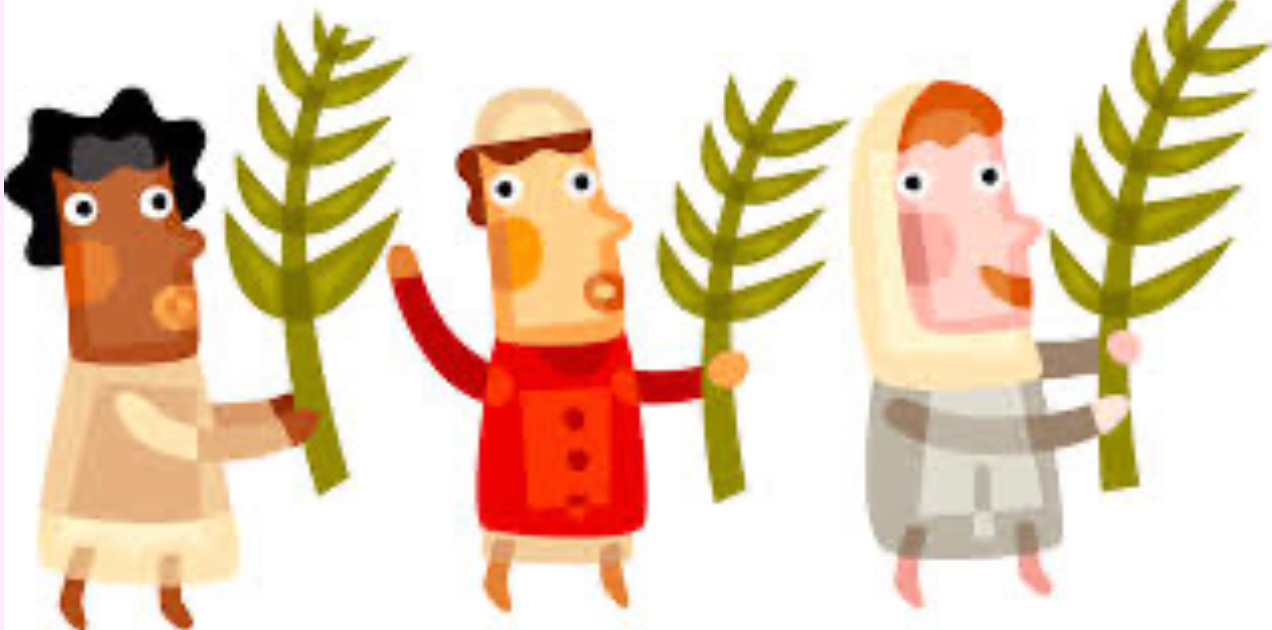
Image Source: Wannapik Studio (Creator), Palm Sunday Parishioners Carry Palms, Wannapik Studio, CC BY 3.0
Worth reading: How to be a synodal Church on mission? Five perspectives for theological exploration in view of the Second Session of the XVI Ordinary General Assembly of the Synod of Bishops