

Introduction
It seems entirely appropriate to use the Beatitudes reading from Matthew’s Gospel to celebrate the Feast of All Saints. As Fr Segundo Galilea has stated, the Beatitudes “reveal the attitudes Jesus had, and hence those his followers should have” (p.11). Moreover, they are the “be” attitudes required for entry into God’s kingdom.
As I worked on this Gospel Enquiry, I realised that the Beatitudes required more than one Gospel Enquiry. The nine sayings could be explored by means of nine enquiries. And so, I decided to write one enquiry each month based on each saying and post them in my own Substack (Pat’s Substack), after this enquiry.
Jesus showed through his life and mission that all people are called to make a total commitment to God who has already won the battle with evil. Believing this to be true, I present the following Gospel Enquiry.
The Gospel
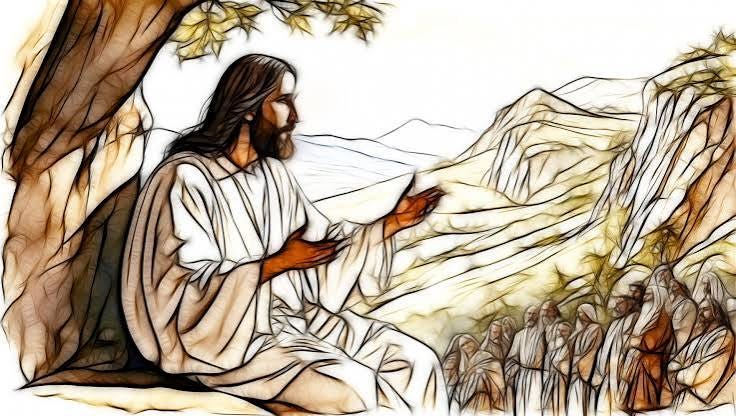
Seeing the crowds, Jesus went up the hill. There he sat down and was joined by his disciples. Then he began to speak. This is what he taught them:
‘How happy are the poor in spirit; theirs is the kingdom of heaven.
Happy the gentle: they shall have the earth for their heritage.
Happy those who mourn: they shall be comforted.
Happy those who hunger and thirst for what is right: they shall be satisfied.
Happy the merciful: they shall have mercy shown them.
Happy the pure in heart: they shall see God.
Happy the peacemakers: they shall be called sons of God.
Happy those who are persecuted in the cause of right: theirs is the kingdom of heaven.
‘Happy are you when people abuse you and persecute you and speak all kinds of calumny against you on my account. Rejoice and be glad, for your reward will be great in heaven.’ (Matthew 5:1-12)
The Enquiry
See
The Sermon on the Mount is a collection of sayings attributed to Jesus. The first saying focuses on “the poor in spirit”. What does this mean? Does it convey what St Bernard of Clairvaux (1090-1153) says: “…we who are overwhelmed in wretchedness”? Does poverty have a spiritual dimension?
Fr Segundo Galilea (1928-2010), a Chilean liberation theologian, identifies the poor as “[t]he destitute, the abandoned, the forsaken” (p.15) How do some people become “poor in spirit”? Is poverty a “random,” naturally occurring human condition? Or are there structural causes for poverty?
Why does Jesus tell the “poor in spirit” that the kingdom of heaven is theirs? What does this reveal about his worldview? And what does it say about his reason for teaching people about how to enter the kingdom of heaven?
Judge
Jesus did not come to help people feel good about themselves. He came to call people to repent. How true is this of the saying that we are considering in this Enquiry?
Why does Jesus tell the “poor in spirit” that they are blessed and that the kingdom of heaven is theirs?
What do you find challenging in this presentation of Jesus’ worldview?
Act
What does this Beatitude call people to do? Identify actions that promote the worldview represented by this saying of Jesus.
Choose one small action that you can carry out and that will contribute to bringing about the transformation of the world and yourself.
Who can you involve in your action, when, where and how often?
Image Source: Jesus’ Sermon on the Mount, public domain pictures.net, CCO
Worth reading: Galilea, S. (1984). The beatitudes: to evangelize as Jesus did. Orbis Books.