

Introduction
Recently, an Australian political leader called for a monocultural Australia. She is not alone in promoting the view that in Australia progress can only be achieved through uniformity. It is not a view that I hold. And as I prepared this Gospel Enquiry, I found myself focusing on the gift of human dignity, which God gives to every human being,
Pope Leo XIV wrote in his encyclical Magnifica Humanitas, that “together … [in dialogue with all men and women of our time], we seek to identify new paths for the common good and for promoting a dignified life for all” (MH, 2).
The Gospel you are about to read provides us with the principle governing the paths we take to ensure the dignity of all people: “the presence of Christ, who comes and guides history toward its fulfilment” (MH,22).
So, may we be courageous people who trust Jesus to guide us and whose Spirit will strengthen us as we speak and act in his name.
The Gospel
Jesus instructed the Twelve as follows: ‘Do not be afraid. For everything that is now covered will be uncovered, and everything now hidden will be made clear. What I say to you in the dark, tell in the daylight; what you hear in whispers, proclaim from the housetops.
‘Do not be afraid of those who kill the body but cannot kill the soul; fear him rather who can destroy both body and soul in hell. Can you not buy two sparrows for a penny? And yet not one falls to the ground without your Father knowing. Why, every hair on your head has been counted. So there is no need to be afraid; you are worth more than hundreds of sparrows.
‘So if anyone declares himself for me in the presence of men, I will declare myself for him in the presence of my Father in heaven. But the one who disowns me in the presence of men, I will disown in the presence of my Father in heaven.’ (Matthew 10:26-33)
The Enquiry
See
What happens in this scene from Matthew’s Gospel? What do you learn about Jesus and his mission from his instructions to his apostles? What do you learn about the society in which he and his apostles live?
Are fear and courage relevant in this Gospel? What do you know about the apostles that tells you how they were affected by what Jesus tells them?
Why does Jesus speak to his disciples in this way? What has he experienced about his followers that would lead him to warn them about the people they will meet?
Judge
How have you been affected by Jesus’ instructions that you have read in this Gospel?
What is Jesus’ ideal world like? Where and when have you experienced this world?
What does Jesus say here that makes you feel uncomfortable about how you live your life? What does he say that gives you hope for yourself and for the world?
Act
Based on what you have read in this Gospel, what is the change in you and in the world to which Jesus commits himself?
What small action can you carry out that will contribute to bringing about this change in yourself and in the world?
Who can you involve in your action, when, where and how often?
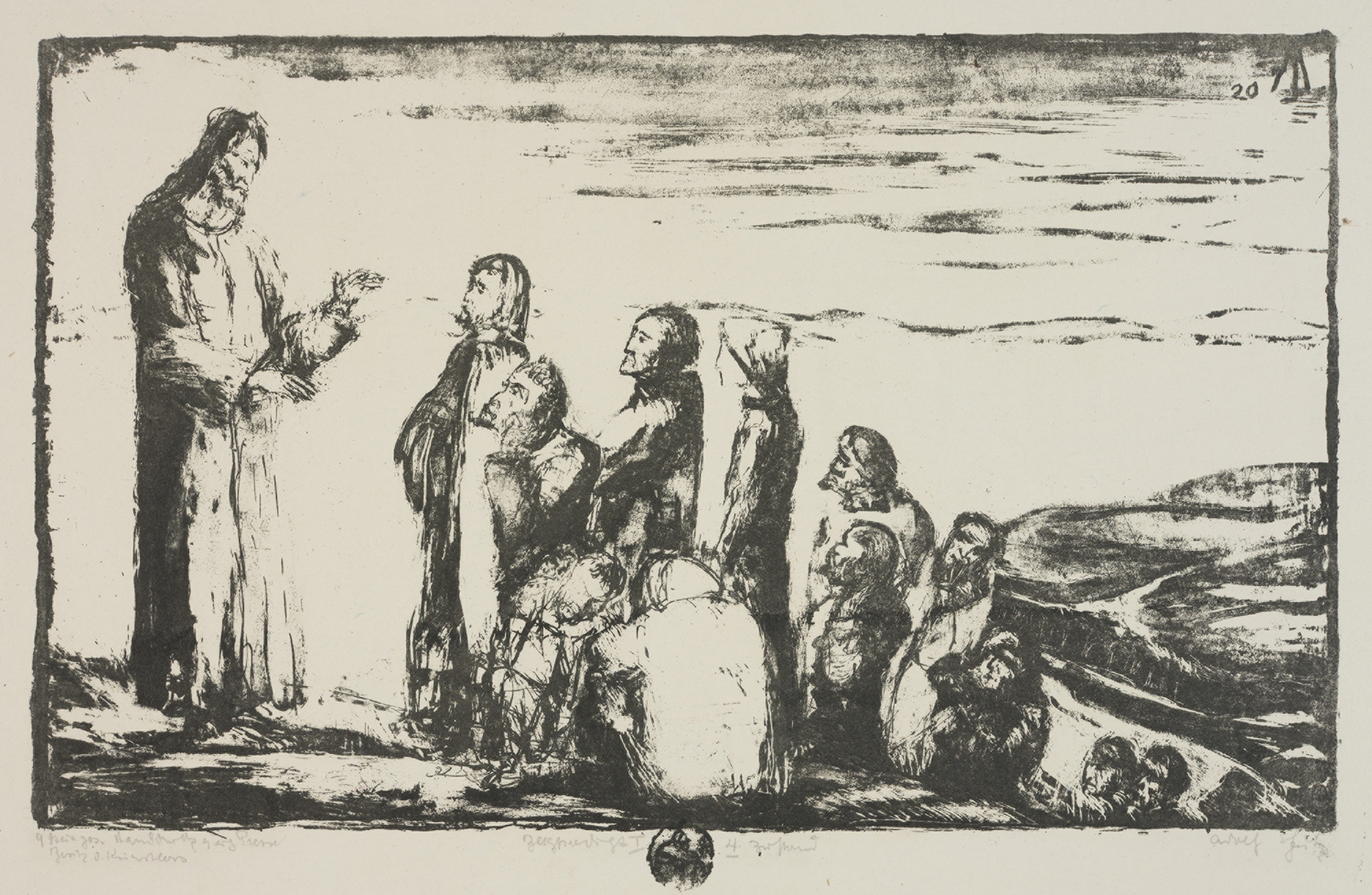
Image Source: Adolf Jutz (1887-1045) (Creator), Graphic of the Sermon on the Mount (Matthew 5:1-7:28). In the National Museum in Szczecin, Poland. muzeach.pl, PDM 1.0